
Table of Contents
- What Is a Spore Syringe?
- What Is a Liquid Culture?
- Why the Legal Distinction Between Spores and Liquid Culture Matters
- What Does a Spore Syringe Show You That a Liquid Culture Cannot?
- What Does a Liquid Culture Show You That a Spore Syringe Cannot?
- Which Format Should a Microscopist Choose?
- Key Takeaways
- Sources
- FAQs
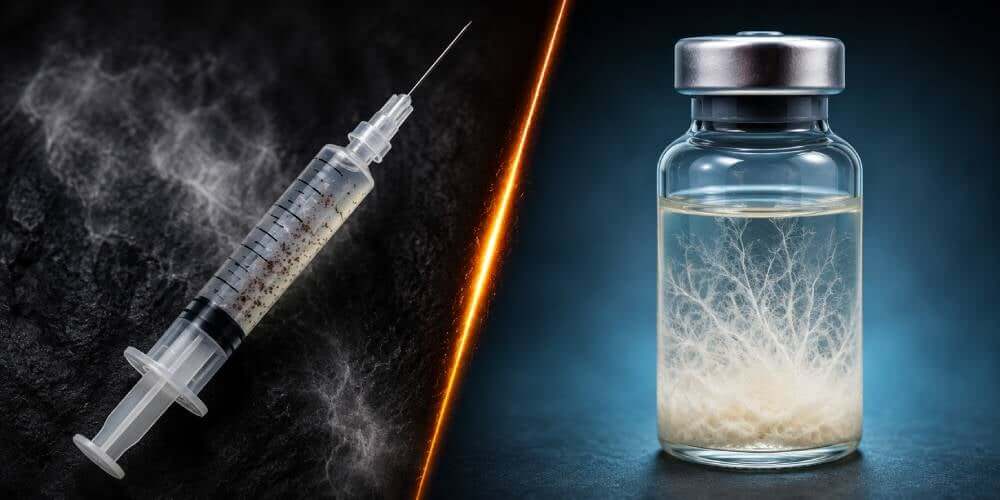
A spore syringe contains dormant basidiospores suspended in sterile distilled water — no controlled substances, federally unscheduled in 46 states. A liquid culture contains living mycelium in a nutrient solution; for Psilocybe cubensis, that mycelium actively produces psilocybin, making it a Schedule I controlled substance under federal law. For microscopy research, the spore syringe is the only legally appropriate format for psilocybin-producing species and the correct tool for spore morphology documentation.
Most comparisons of spore syringes and liquid cultures answer the wrong question. They assume the reader wants to know which format produces mushrooms faster, which colonizes substrate more reliably, which gives better yields. Those are grower questions, and they miss the point entirely for a researcher working within a legal framework.
For a microscopist studying Psilocybe cubensis spore morphology, the more useful question is: what does each format actually let you observe, and what are the legal boundaries that define which format you can legally possess? The answer to both parts of that question shapes every purchasing decision a serious researcher makes.
Research Format
What Is a Spore Syringe?
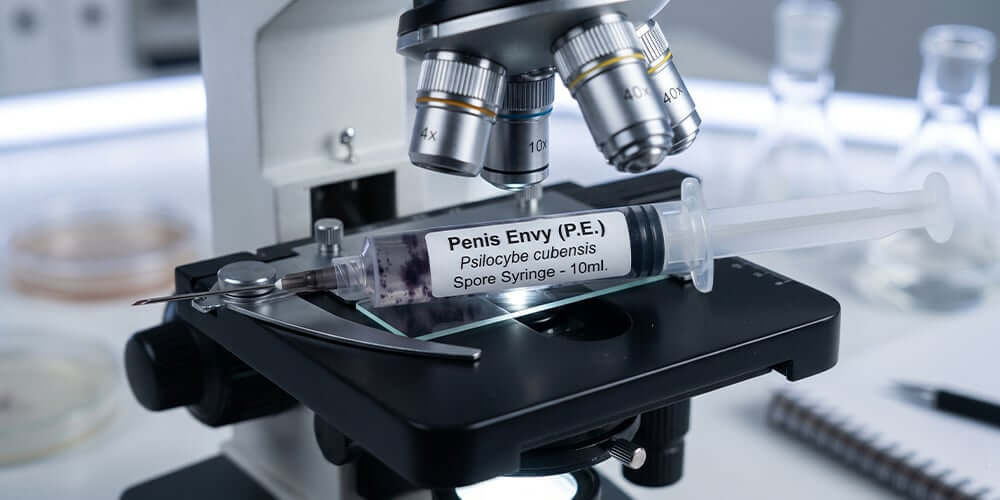
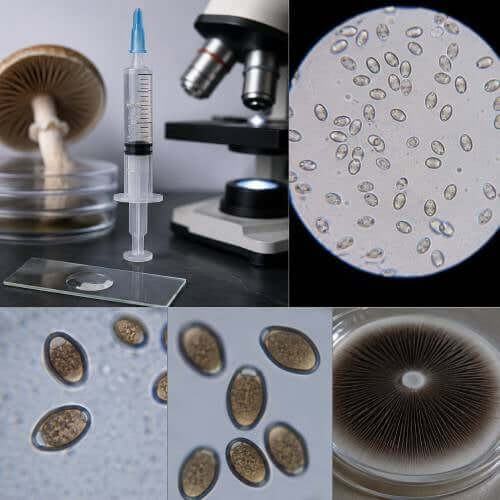
A spore syringe is a sterile syringe — typically 10cc — containing basidiospores of a fungal species suspended in sterile distilled water. For Psilocybe cubensis and related species, those spores are collected from a mature spore print, introduced into purified water in a cleanroom environment, mixed thoroughly to achieve even distribution, and drawn into the syringe.
What matters for microscopy: the spores in a research-grade syringe are dormant. They are single-celled reproductive structures, roughly ellipsoid in shape, averaging 11.5 to 17 microns in length for Psilocybe cubensis. Under a compound microscope at 400x or higher magnification, you can observe spore wall thickness, color (subrhomboid with a brownish-purple pigmentation under brightfield), surface texture, and the distinctive germ pore — a small, thin-walled opening through which the germ tube emerges during germination.
The syringe format makes slide preparation straightforward. A single drop from a vigorously shaken syringe placed on a clean glass slide with a cover slip gives you thousands of individual spores to examine. Adjust illumination, and you can spend hours on morphometric documentation — measuring spore dimensions with an eyepiece micrometer, comparing populations, and building a reference dataset.
Dormant Spores Only
Spore syringes contain pre-germination basidiospores — metabolically inert, containing no psilocybin. This is what makes them federally unscheduled in 46 states.
Morphometric Precision
Psilocybe cubensis basidiospores measure 11.5–17 µm in length. Spore syringes give you a dense, measurable population for calibrated eyepiece micrometry work.
High Genetic Diversity
Each basidiospore is a product of meiotic recombination — a genetically unique individual. A single syringe provides a diverse population for intraspecific variation studies.
Extended Shelf Life
Research-grade spore syringes from Magic Spore Labs retain viability for 12–18 months when stored refrigerated at 2–8°C and kept away from direct light.
Research Format
What Is a Liquid Culture?
A liquid culture (LC) is a different organism at a different life stage. It contains living mycelium — the branching, thread-like hyphal network that forms once two compatible spores germinate and fuse. That mycelium is suspended in a nutrient-enriched solution, typically containing a carbon source such as light malt extract or honey at concentrations between 2 and 4 percent, held in sterile conditions.
The biological distinction is absolute. A spore syringe contains pre-germination genetic material. A liquid culture contains post-germination, actively metabolizing fungal tissue. For Psilocybe cubensis, that means a liquid contains hyphae that are actively running the biosynthetic pathway for psilocybin production. Research published in Angewandte Chemie by Fricke, Blei, and Hoffmeister (2017) mapped the four-enzyme cascade — PsiD, PsiK, PsiM, and PsiH — responsible for converting tryptophan to psilocybin. That pathway operates in mycelium, not in dormant spores.
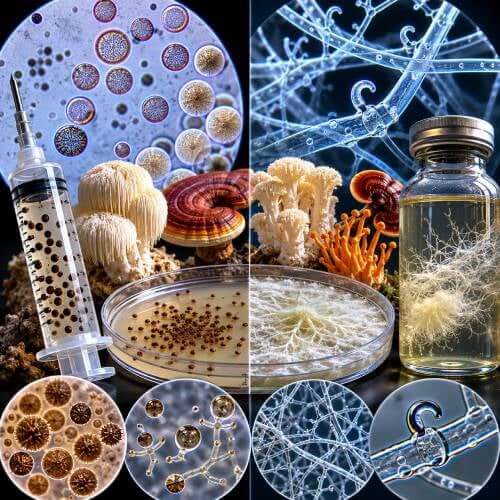
Under the microscope, liquid reveals different things than a spore syringe. You are looking at hyphal architecture: branching angle, septation patterns, clamp connections (when present), and early-stage tissue organization. These observations are valuable in their own right for fungal cell biology research, but they require a fundamentally different preparation technique and a fundamentally different legal framework to possess.
Legal & Regulatory
Why the Legal Distinction Between Spores and Liquid Culture Matters
This is the part most comparison guides skip entirely, and it is arguably the most practically important information for a researcher purchasing either format.
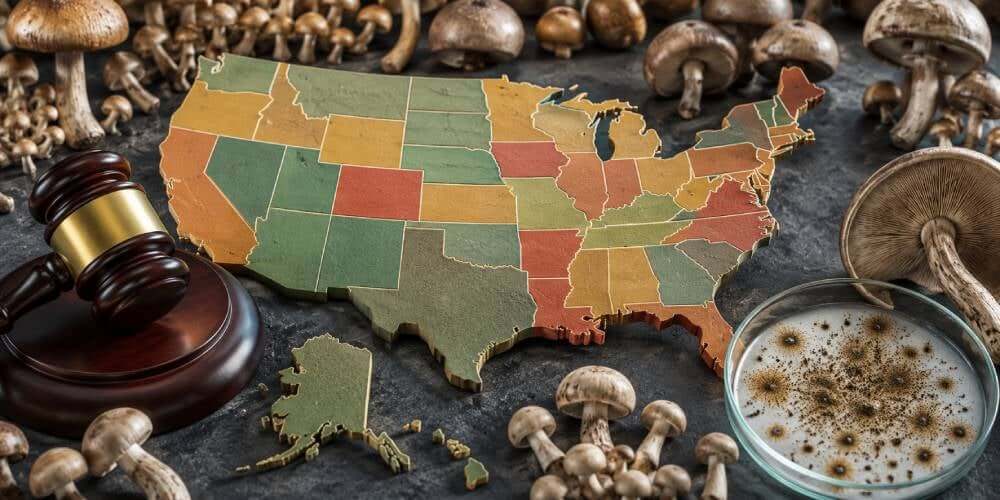
Federal law schedules psilocybin and psilocin as Schedule I controlled substances under the Controlled Substances Act. Neither Psilocybe cubensis the species nor fungal spores as a category appear in the scheduling language. In January 2024, DEA Drug and Chemical Evaluation Section Chief Terrence Boos confirmed in writing that if spores do not contain psilocybin or psilocin, the material is not a controlled substance under the CSA. Ungerminated basidiospores of Psilocybe cubensis contain no detectable psilocybin. They are federally unscheduled.
Liquid culture of Psilocybe cubensis is a different matter. The mycelium it contains produces psilocybin. That means a Psilocybe cubensis liquid culture — as opposed to a gourmet species liquid culture — contains a Schedule I controlled substance under federal law. It is not legally equivalent to a spore syringe. Some vendors market "isolated spore syringes" or products with liquid-like characteristics for research purposes, but the key legal question is always whether the material contains psilocybin or psilocin. If mycelium is present and actively producing alkaloids, the material is scheduled regardless of how it is labeled.
For gourmet and functional species — lion's mane (Hericium erinaceus), reishi (Ganoderma lucidum), oyster (Pleurotus ostreatus), cordyceps (Cordyceps militaris) — liquid cultures contain no controlled substances and are entirely legal to purchase, possess, and study in all 50 states. The legal distinction applies specifically to psilocybin-producing species.
Shipping Restriction: Magic Spore Labs ships to all U.S. states except California, Idaho, and Georgia.
| Characteristic | Spore Syringe | Liquid Culture (Psilocybe spp.) | Liquid Culture (Gourmet spp.) |
|---|---|---|---|
| Contents | Dormant basidiospores in sterile water | Living mycelium in nutrient solution | Living mycelium in nutrient solution |
| Psilocybin present | No — undetectable pre-germination | Yes — produced by active mycelium | No — species does not produce psilocybin |
| Federal legal status | Unscheduled in 46 states | Schedule I — controlled substance | Unscheduled — legal in all 50 states |
| What you observe under microscope | Spore morphology: size, shape, wall, germ pore, pigmentation | Hyphal architecture, septation, branching, clamp connections | Hyphal architecture, septation, branching, clamp connections |
| Shelf life (refrigerated) | 12–18 months at 2–8°C | 2–6 months; degrades faster | 2–6 months; degrades faster |
| Slide preparation | Single drop on slide, cover slip, immediate use | Dilution often needed; aseptic transfer required | Dilution often needed; aseptic transfer required |
| Genetic variability | High — each spore is a unique genetic individual from meiotic recombination | Low — clonal mycelial tissue; single genetic lineage | Low — clonal mycelial tissue; single genetic lineage |
Microscopy
What Does a Spore Syringe Show You That a Liquid Culture Cannot?
Taxonomy begins with the spore. In mycological identification, spore morphology is one of the primary diagnostic characters used to distinguish species within and across genera. For Psilocybe cubensis, the relevant observations are accessible only through a research-grade spore syringe — not through mycelial preparations of any kind.
- Spore dimensions: Psilocybe cubensis basidiospores measure approximately 11.5 to 17 microns in length by 8 to 11 microns in width. Accurate micrometry requires a calibrated eyepiece graticule and a stage micrometer.
- Spore shape: Subrhomboid to ellipsoid in face view; flattened in side view. The shape deviates subtly between strains — a morphological signature that taxonomists document during formal species work.
- Germ pore: Psilocybe basidiospores have a distinct, truncate germ pore at the apical end. Its presence and size are taxonomically significant and distinguishable at 1000x oil immersion.
- Wall pigmentation: The spore wall appears brownish-purple under brightfield illumination. Melzer's reagent can be used to test for amyloid reactions, though Psilocybe spores are non-amyloid.
- Population homogeneity: A good spore syringe from a research-grade vendor gives you a large population to examine. Outlier spores — malformed, clumped, or anomalously sized — can be documented and set aside, leaving a clean reference population for morphometric work.
None of this observation is possible with liquid culture. You cannot examine basidiospore germ pores or spore wall pigmentation from a sample of mycelium. Those are two different stages of the fungal life cycle, and they require different starting materials.
Microscopy
What Does a Liquid Culture Show You That a Spore Syringe Cannot?
For gourmet and functional species where liquid culture is legally unproblematic, the format opens up a different research dimension entirely. Hyphal architecture — the branching patterns, growth angle, septation frequency, and cellular organization of fungal mycelium — is only visible once spores have germinated and begun forming tissue.
Clamp connections are one example. These small hook-like structures form at hyphal septa in dikaryotic mycelium during cell division, ensuring that each newly divided cell receives one nucleus from each of the two compatible parental nuclei. Their presence is taxonomically informative and visually distinct under high magnification. You will not see them in a spore syringe preparation because they are a feature of established mycelium, not ungerminated spores.
For researchers studying species like Hericium erinaceus (lion's mane), Ganoderma lucidum (reishi), or Cordyceps militaris, Magic Spore Labs' functional spore collection paired with a legal liquid culture from a compliant supplier gives a complete toolkit: examine spore morphology first, then observe the mycelial development of the same species. The two formats are complementary, not competing.
Research Guidance
Which Format Should a Microscopist Choose?
For Psilocybe cubensis research in any of the 46 states where spores are legal, the answer is unambiguous: a spore syringe is your format. It is the only legally available option from a compliant vendor. It is also the appropriate format for the research activity — spore morphology documentation, taxonomic identification, population studies, and microscopy technique practice. Liquid of a psilocybin-producing species is a Schedule I controlled substance and is not carried by any compliant research vendor.
For gourmet and functional species, the choice depends on the research question. If you are documenting spore morphology or building a reference collection, start with a spore syringe or spore print. If you want to observe mycelial development, hyphal architecture, or growth dynamics under the microscope, a liquid culture from a functional species provides exactly that. Both formats are legal, and both add distinct scientific value.
Disclaimer: All spores offered by Magic Spore Labs are intended for microscopy, taxonomy, and research purposes only. Spores are not intended for cultivation. It is the customer's responsibility to know and comply with all local, state, and federal laws regarding possession and use of spore products.
Summary
Key Takeaways
The spore syringe vs liquid culture distinction is both biological and legal — and understanding both dimensions is essential for any researcher working with Psilocybe cubensis or functional species.
Spore Syringe
Dormant basidiospores in sterile water. Federally unscheduled in 46 states — no psilocybin present pre-germination. The correct format for spore morphology research: documenting dimensions, shape, germ pore, wall pigmentation, and population characteristics. Shelf life 12–18 months refrigerated. Slide prep is a single drop — simplest possible preparation for microscopy.
Liquid Culture
Living mycelium in nutrient solution. For Psilocybe cubensis: Schedule I controlled substance — mycelium actively produces psilocybin. For gourmet/functional species: entirely legal, no controlled substances. Allows observation of hyphal architecture, septation, and clamp connections. Degrades in 2–6 months and requires more complex slide preparation.
Research-Grade Psilocybe Cubensis Spore Syringes
Magic Spore Labs' spore syringes are prepared in a cleanroom environment from verified spore prints, suspended in sterile distilled water, and packaged in 10cc luer-lock syringes. Each syringe is the only legally appropriate format for Psilocybe cubensis microscopy research in the 46 states where spore possession is permitted.
Sources
- Fricke, J., Blei, F., & Hoffmeister, D. (2017). Enzymatic Synthesis of Psilocybin. Angewandte Chemie International Edition, 56(40), 12352–12355. https://doi.org/10.1002/anie.201705489
- Stamets, P. (1996). Psilocybin Mushrooms of the World: An Identification Guide. Ten Speed Press. [Spore morphology reference for Psilocybe cubensis — 11.5–17 × 8–11 µm, subrhomboid, germ pore truncate]
- U.S. Drug Enforcement Administration, Drug and Chemical Evaluation Section. Boos, T. (January 2024). Written confirmation regarding psilocybin spore scheduling under the Controlled Substances Act.
- Controlled Substances Act, 21 U.S.C. § 812, Schedule I (c)(6) — psilocybin; § 812, Schedule I (c)(7) — psilocin.
- Alexopoulos, C.J., Mims, C.W., & Blackwell, M. (1996). Introductory Mycology, 4th ed. John Wiley & Sons. [Hyphal architecture, clamp connections, and septation in basidiomycetes]
- SporesMD. (2024). Spore Syringe vs Liquid Culture: What's The Difference.
Understanding the difference between a spore syringe and a liquid culture is foundational for any researcher working with Psilocybe cubensis or functional fungal species. The mushroom spore syringe is not simply the legally safer choice — it is the biologically appropriate tool for the research activity it enables. Magic Spore Labs provides research-grade spore syringes prepared under cleanroom conditions for microscopists who need reliable morphological specimens, consistent population density, and documented spore viability for serious taxonomy and microscopy work.
FAQs
What is the difference between a spore syringe and a liquid culture?
A spore syringe contains dormant basidiospores suspended in sterile distilled water — no psilocybin present, federally unscheduled in 46 states. A liquid culture contains living mycelium in a nutrient-enriched solution. For Psilocybe cubensis, that mycelium actively produces psilocybin, making it a Schedule I controlled substance under the Controlled Substances Act. They are different biological materials at different life cycle stages and are not legally interchangeable.
Is a Psilocybe cubensis liquid culture legal to possess?
No. A Psilocybe cubensis liquid culture contains actively growing mycelium, which produces psilocybin — a Schedule I controlled substance under federal law. Spore syringes of the same species are federally unscheduled in 46 states because ungerminated basidiospores contain no detectable psilocybin. No compliant research vendor sells Psilocybe cubensis liquid culture. If you are researching psilocybin-producing species, a spore syringe is the only legally appropriate format available from a compliant supplier.
Can you use a spore syringe for microscopy research?
Yes — spore morphology documentation is the primary research use for a spore syringe. Shake the syringe thoroughly to distribute spores evenly, express a single drop onto a clean glass slide, apply a cover slip, and examine under a compound microscope starting at 100x. At 400x to 1000x oil immersion you can observe Psilocybe cubensis basidiospore dimensions (11.5–17 µm), subrhomboid shape, brownish-purple wall pigmentation, and the distinctive truncate germ pore — all key morphological characters for taxonomic documentation.