
Table of Contents
- The Scientific Name of Penis Envy Mushrooms
- Origin of the Penis Envy Strain: What Is Actually Known
- Macroscopic Features of Penis Envy: What Makes It Visually Distinct
- Penis Envy Spore Morphology: What You See Under the Microscope
- Preparing a Penis Envy Spore Slide: Protocol and Practical Notes
- Penis Envy Sub-Strains: Research Relevance of Each Variant
- PE Spores vs. Golden Teacher Spores
- What Researchers Should Know About PE Spore Syringes
- Sources
- FAQs
Penis Envy is a cultivated strain of Psilocybe cubensis (Earle) Singer — not a distinct species. Its basidiospores are morphologically identical to all other P. cubensis strains: subellipsoid, 11–17 × 7–12 micrometers, dark purple-brown in deposit, smooth-walled, with a truncate germ pore. What sets Penis Envy apart at the research level is a heritable velum anomaly that prevents the cap from opening fully, dramatically restricting sporulation and making research-grade Penis Envy spore syringe material among the most selective to source and prepare.
The Scientific Name of Penis Envy Mushrooms
The scientific name of Penis Envy mushrooms is Psilocybe cubensis (Earle) Singer. Penis Envy is a cultivated strain — an informal variety designation used within the mycology community — not a distinct species. Its complete taxonomic classification places it in Kingdom Fungi, Phylum Basidiomycota, Class Agaricomycetes, Order Agaricales, Family Hymenogastraceae, Genus Psilocybe, Species P. cubensis, with the accepted binomial Psilocybe cubensis (Earle) Singer. Franklin Sumner Earle first described the species in 1906 from Cuban specimens, placing it in genus Stropharia as Stropharia cubensis. Rolf Singer transferred it to Psilocybe in 1948, establishing the current binomial. The family placement has been updated from the older Strophariaceae to Hymenogastraceae following molecular phylogenetic analyses. All common synonyms — Stropharia cubensis, Stropharia cyanescens, Naematoloma caerulescens — refer to the same species.
There is no formal taxonomic distinction between Penis Envy and any other named P. cubensis strain. Strain names are informal community designations reflecting phenotypic variation produced through selective isolation — not species-level differences recognized by the International Code of Nomenclature for algae, fungi, and plants.
Penis Envy Mushroom Spore Syringe
$22.99
$24.99
PE#6 (Penis Envy 6) Mushroom Spore The Penis Envy #6 Mushroom Spore Syringe from Magic Spore Labs delivers basidiospores from the most systematically refined expression of the Penis Envy lineage available in the Psilocybe cubensis research catalog — a sixth-generation… read more

Origin
Origin of the Penis Envy Strain: What Is Actually Known
The origin of Penis Envy is better documented than most named P. cubensis strains, though it still involves a degree of mycological folklore that should be handled with appropriate skepticism. The most widely accepted account, reported in detail by journalist Hamilton Morris and corroborated across multiple independent sources, runs as follows. In the early 1970s, ethnobotanist Terence McKenna traveled to the Colombian Amazon. During that trip, he reportedly collected spore prints from an unusually large and morphologically distinct Psilocybe cubensis specimen growing in cattle dung. Those spore prints eventually reached Dr. Steven Pollock, a physician and mycologist based in Texas who was conducting research into psilocybin-producing fungi. Pollock isolated and cultured the material across multiple generations, selecting for the morphological characteristics — dense, columnar stems and minimal cap development — that define the strain today. Pollock was murdered under unsolved circumstances in 1981, and his research materials were seized.
The strain was subsequently distributed through the underground mycology community, eventually reaching wider circulation via mail-order spore vendors and publications including the Psilocybin Mushroom Handbook. A 2025 PMC review on P. cubensis strains by Ramirez-Cruz and colleagues noted that PE's distinct morphological characteristics have made it one of the most recognized strains in the research community, while acknowledging that formal academic documentation of strain-level genetics remains limited due to legal restrictions on psilocybin research.
Why the origin matters for research: The PE mutation — particularly its velum anomaly and reduced sporulation — appears to be the product of iterative selective isolation from a single unusual wild-collected specimen, not random population drift. This has direct implications for understanding the genetic stability and heritability of strain-level morphological traits in Psilocybe cubensis.
Morphology
Macroscopic Features of Penis Envy: What Makes It Visually Distinct
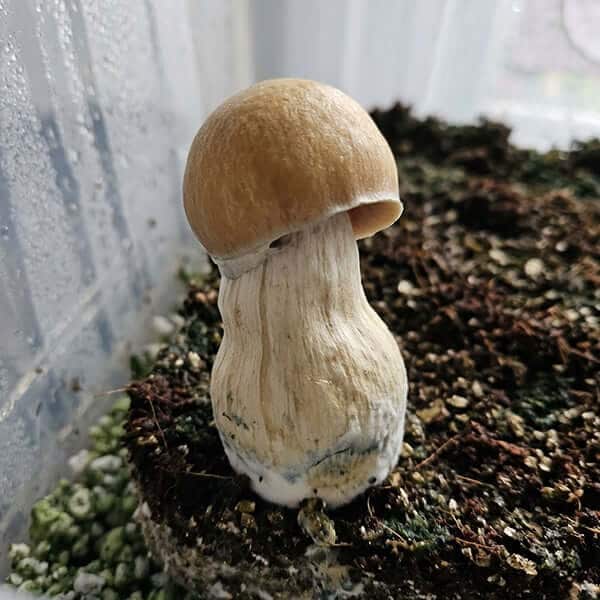
Among all common P. cubensis strains, Penis Envy has the most immediately recognizable macroscopic morphology. Three features distinguish it from the baseline cubensis phenotype at a glance.
Stipe (stem): Dramatically thicker and denser than most cubensis strains, often 2–3 cm in diameter and stout in proportion to height. The stem is solid rather than hollow in many specimens, or nearly so. Coloration is white to off-white, often developing blue-green bruising where the tissue is compressed or damaged — a species-level characteristic of P. cubensis.
Cap (pileus): Significantly underdeveloped relative to stem size. The cap rarely expands to a flat or convex shape; it typically remains in a closed to partially open position with a distinctly small diameter relative to stem width, giving the cap a persistently bulbous appearance throughout development.
Velum and sporulation: The partial veil (velum partiale) in P. cubensis normally covers the developing gills until the cap expands and the veil tears, forming the annulus on the stipe and exposing the gill surface for spore release. In Penis Envy, the velum is structurally anomalous — it remains intact or partially intact as the cap fails to open fully, physically restricting spore release. A single Golden Teacher cap may deposit hundreds of millions of spores in a print; a comparable PE specimen may deposit only a fraction of that, or in some specimens, virtually nothing. This velum anomaly is a heritable morphological characteristic of the PE genetic lineage, selected for and fixed through Pollock's isolation work — not a cultivation defect.
Microscopy
Penis Envy Spore Morphology: What You See Under the Microscope
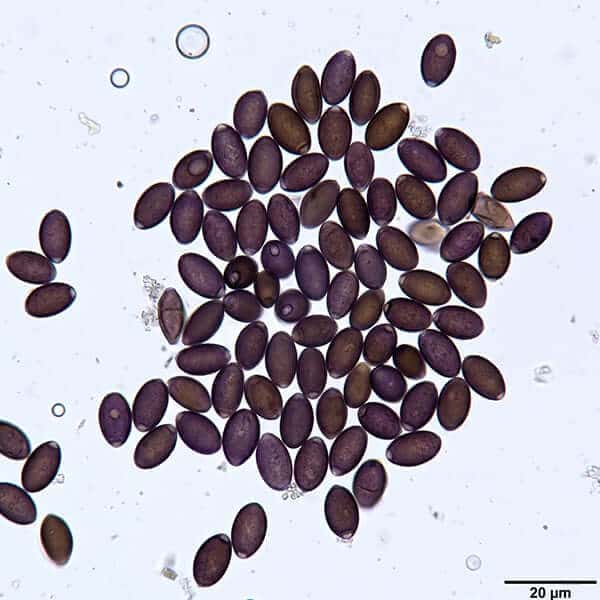
Despite all its macroscopic distinctiveness, Psilocybe cubensis PE spores are morphologically identical to every other P. cubensis strain at the species level. Dimensions run 11–17 micrometers in length by 7–12 micrometers in width — consistent with the full species range documented by Paul Stamets in Psilocybin Mushrooms of the World (1996) and corroborated across multiple mycological studies. Within a well-prepared PE spore syringe slide, population measurements will cluster in the 12–15 µm range, matching the distribution expected from a Golden Teacher spore morphology slide. Shape is subellipsoid to subrhomboid in face view, slightly flattened in side view, bilaterally symmetrical. The germ pore is truncate at the apical end, visible at 1000x oil immersion, and taxonomically significant at the genus level — not the strain level. Wall structure is smooth with no surface ornamentation. Pigmentation is dark purple-brown under transmitted light; non-amyloid.
The one observable difference is spore density on the prepared slide. Because PE specimens produce fewer spores, a PE spore syringe prepared from the same volume of source material will typically yield a lower spore count per milliliter than a Golden Teacher syringe. On the slide, this presents as a less dense spore population — more empty field between specimens. This is not a quality defect. A reputable vendor compensates by using more source material per syringe and confirming minimum viable spore counts before release. For researchers evaluating preparation formats, our guide on spore syringe vs liquid culture covers the practical differences.
Preparing a Penis Envy Spore Slide: Protocol and Practical Notes
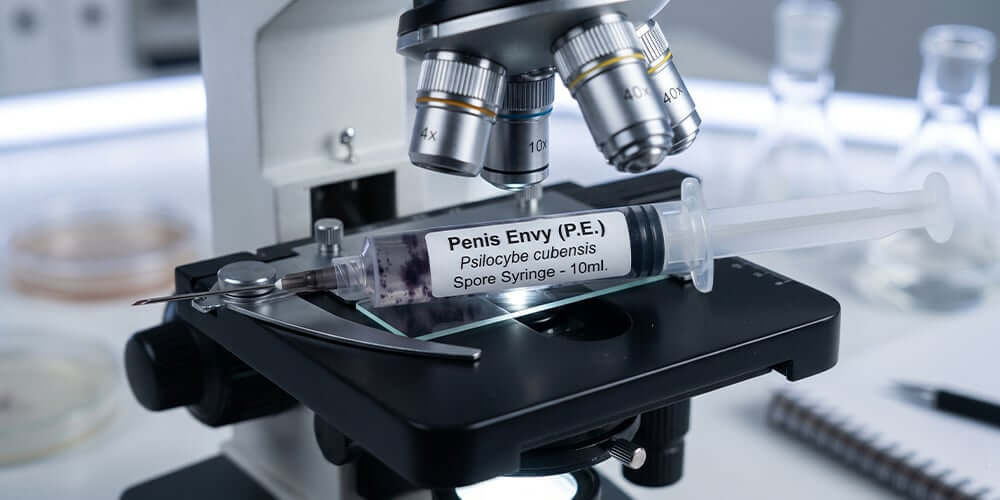
The standard wet mount protocol for basidiospore microscopy applies to PE spore syringes, with one practical adjustment given the lower spore density. Following this sequence produces consistent, well-populated slides even from material with characteristically reduced sporulation volume.
- Shake thoroughly before use. Spores settle in suspension over time. Vigorous agitation for 60 seconds before expressing any liquid breaks up settled aggregates and redistributes spores evenly through the medium. This applies to any spore syringe but is especially important with PE material.
- Use a slightly larger drop volume. Where a single 10-microliter drop from a Golden Teacher syringe gives a densely populated slide, PE material may benefit from 15–20 microliters to achieve equivalent visual field density. Lower starting concentration means more liquid volume is needed to ensure representative populations are visible per field of view.
- Begin at 100x to confirm coverage. Survey the slide at low magnification before investing time at higher objectives. If spores are too sparse to find representative isolated specimens, prepare a second slide with a slightly larger drop before continuing. With PE, this preliminary check saves significant time.
- 400x for primary morphological observation. Adjust condenser aperture to enhance contrast. At this magnification, confirm subellipsoid shape, overall pigmentation, and germ pore presence. Document typical and atypical spores separately for comparative reference.
- 1000x oil immersion for measurement and detail. Apply immersion oil to the cover slip surface, engage the 100x objective, and proceed with micrometry using a calibrated eyepiece graticule. Record length and width measurements for a minimum of 20 representative spores. Note population-level observations about uniformity, spore aggregates, or pigmentation variation.
Sub-Strains
Penis Envy Sub-Strains: Research Relevance of Each Variant
The PE genetic lineage has produced several named sub-strains through subsequent isolation work. From a microscopy and research perspective, sporulation behavior and pigmentation are the key differentiators — individual spore morphology remains species-consistent across all of them. For a detailed look at the albino variant, see the Albino Penis Envy spore swab guide.
| Sub-Strain | Sporulation | Notable Microscopy Characteristic |
|---|---|---|
| Penis Envy (original) | Very low | Sparse slide density; standard species-level morphology |
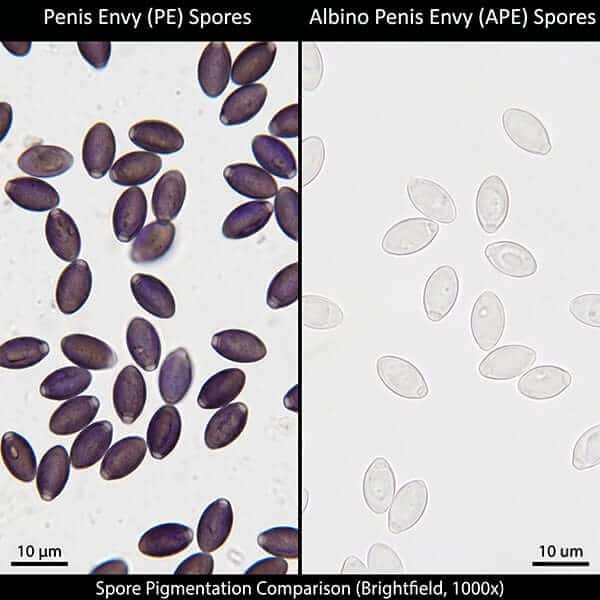
| Albino Penis Envy (APE) | Extremely low | Spore pigmentation notably reduced — appearing pale brown to near-translucent under brightfield; germ pore and wall structure remain observable |
| Penis Envy Uncut | Extremely low | Velum anomaly most pronounced of all PE variants; cap veil rarely tears at all; sourcing viable spore syringes is the most challenging of the sub-strains |
| Penis Envy #6 (PE6) | Low to moderate | Cross with Texas cubensis genetics improves sporulation; slide density will be higher than original PE; morphology unchanged at species level |
| Tidal Wave APE (TW-APE) | Low | PE × Tidal Wave cross; exhibits hybrid morphological characteristics; pigmentation may be intermediate between albino and standard dark-pigmented PE spores |
The most practically important takeaway from the sub-strain data: Albino Penis Envy spores are not white or colorless under the microscope. The albino phenotype reflects reduced eumelanin production in the basidiocarp tissue. Spore wall pigmentation, while reduced compared to standard penis envy spores, remains visible as pale brown under brightfield illumination. A slide of APE spores from a quality syringe will show subtler pigmentation than a Golden Teacher slide — not a population of transparent or invisible spores. This distinction matters for accurate comparative documentation. Take a look at our Penis Envy Spores vs. Albino Penis Envy Spores comparison in the photo below.
Comparison
PE Spores vs. Golden Teacher Spores
At the individual spore level, Penis Envy spores and Golden Teacher spores are morphologically indistinguishable under the microscope — both are Psilocybe cubensis and share all species-level features. The practical differences as research specimens come down to sporulation volume and slide preparation technique when it comes to both penis envy spores and golden teacher.
Golden Teacher
Species: Psilocybe cubensis. Spore dimensions: 11–17 × 7–12 µm. Shape: subellipsoid. Germ pore: truncate, apical. Wall: smooth, moderate thickness. Pigmentation: dark purple-brown. Sporulation volume: high — dense prints, abundant syringe material. Slide density (standard drop): high. Recommended for beginners: yes — abundant material and consistent spore populations make slide preparation straightforward.
Penis Envy
Species: Psilocybe cubensis. Spore dimensions: 11–17 × 7–12 µm. Shape: subellipsoid. Germ pore: truncate, apical. Wall: smooth, moderate thickness. Pigmentation: dark purple-brown. Sporulation volume: very low — velum anomaly restricts spore release. Slide density (standard drop): moderate to low — increase drop volume to 15–20 µl to compensate. Better suited to intermediate researchers comfortable with patient scanning technique.
Key Takeaways
What Researchers Should Know About PE Spore Syringes
Identical Species-Level Morphology
PE basidiospores are morphologically identical to all other P. cubensis strains: subellipsoid, 11–17 × 7–12 µm, dark purple-brown, smooth-walled, truncate germ pore. No microscopy observation distinguishes PE from Golden Teacher at the individual spore level.
Heritable Velum Anomaly
The partial veil fails to tear fully as the cap expands, restricting gill surface exposure and spore release. This is a fixed, heritable morphological characteristic of the PE lineage — selected across generations during Pollock's isolation work — not a cultivation defect.
APE Pigmentation Reduced, Not Absent
Albino Penis Envy spores appear pale brown under brightfield — not colorless or transparent. Wall structure, germ pore, and shape remain fully observable at 400x and 1000x, consistent with all other species-level morphological features.
Slide Density Requires Adjustment
Quality PE syringes may contain lower spore counts per milliliter than high-sporulation strains. Compensate by increasing drop volume to 15–20 µl and confirming slide coverage at 100x before moving to higher objectives.
Shipping and legal status: Magic Spore Labs ships to all U.S. states except California, Idaho, and Georgia. For a complete state-by-state breakdown, see our guide on are mushroom spores legal.
Disclaimer: All spores offered by Magic Spore Labs are intended for microscopy, taxonomy, and research purposes only. Spores are not intended for cultivation. It is the customer's responsibility to know and comply with all local, state, and federal laws regarding possession and use of spore products.
Penis Envy Liquid Spore Syringe
Research-grade Psilocybe cubensis PE spores in sterile aqueous suspension. Each 10cc syringe is produced from verified source material with confirmed viable spore counts — accounting for the strain's characteristically low sporulation volume. Includes a 1.5" 20-gauge sterile dispensing needle.
Sources
- Earle, F.S. (1906). Stropharia cubensis — original species description from Cuban specimens. Basionym of the current accepted name.
- Singer, R. (1948). New genera of fungi. Mycologia, 40(2), 262–263. Transfer of Stropharia cubensis to Psilocybe cubensis (Earle) Singer.
- Stamets, P. (1996). Psilocybin Mushrooms of the World: An Identification Guide. Ten Speed Press. Spore dimensions 11–17 × 7–12 µm; species-level morphological description.
- Ramirez-Cruz, V., et al. (2025). Exploring Psilocybe cubensis Strains: Cultivation Techniques, Psychoactive Compounds, Genetics and Research Gaps. Journal of Fungi, PMC11856550. https://pmc.ncbi.nlm.nih.gov/articles/PMC11856550/
- Fricke, J., Blei, F., & Hoffmeister, D. (2017). Enzymatic Synthesis of Psilocybin. Angewandte Chemie International Edition, 56(40), 12352–12355. https://doi.org/10.1002/anie.201705489
- Morris, H. (2009, 2021). Penis Envy origin reporting and correction. Vice / Patreon. Hamilton Morris's documented investigation into PE provenance, including best-evidence reconstruction of the McKenna-Pollock chain of custody.
- Guzmán, G. (1983). The Genus Psilocybe. Beihefte zur Nova Hedwigia 74. J. Cramer, Vaduz. Geographic distribution and species-level taxonomy of P. cubensis.
Penis Envy remains one of the most taxonomically compelling Psilocybe cubensis strains available for microscopy research — not because its spores differ from the species baseline, but because the biology behind its velum anomaly raises genuinely informative questions about heritability, morphological selection, and the relationship between macroscopic structure and reproductive output in basidiomycetes. For researchers building a comparative slide library, PE material sourced from a vendor who accounts for its low sporulation in preparation standards offers a distinctive reference point no other common cubensis strain provides. Magic Spore Labs carries the full range of Psilocybe spores for microscopy research, including all PE sub-strains discussed in this profile.
FAQs
What is the scientific name of Penis Envy mushrooms?
The scientific name is Psilocybe cubensis (Earle) Singer. Penis Envy is a cultivated strain within this species, not a taxonomically distinct organism. The binomial Psilocybe cubensis — established when Rolf Singer transferred the species from Stropharia in 1948, based on Franklin Sumner Earle's original 1906 Cuban description — applies to all PE material.
What do Penis Envy spores look like under a microscope?
PE basidiospores are subellipsoid, measuring 11–17 × 7–12 micrometers, dark purple-brown under brightfield illumination, with smooth walls and a truncate germ pore at the apical end. These features are identical to other P. cubensis strains at the species level. The observable microscopy difference is slide density — PE slides will typically show fewer spores per field of view than Golden Teacher slides due to the strain's reduced sporulation volume.
Why do Penis Envy mushrooms produce so few spores?
The cause is a structural anomaly in the velum partiale — the partial veil that covers the developing gills. In most P. cubensis strains, the cap expands fully, the veil tears cleanly, and spores are released from exposed gill surfaces. In PE, the cap rarely opens fully and the velum often remains partially intact, physically restricting spore release. This is a heritable characteristic of the PE genetic lineage selected during isolation by Dr. Steven Pollock in the 1970s, not a sign of poor cultivation conditions.
Are Albino Penis Envy spores visible under a microscope?
Yes. APE spores are visible under a compound microscope, though their pigmentation is notably reduced compared to standard PE. Under brightfield illumination they appear pale brown rather than dark purple-brown, but wall structure, germ pore, and shape remain clearly observable at 400x and 1000x magnification. The albino phenotype affects fruiting body pigmentation, not spore viability or microscopic visibility.
What magnification should I use for Penis Envy spore microscopy?
The same protocol as other P. cubensis strains applies: 100x for initial coverage check, 400x for primary shape and germ pore observation, and 1000x oil immersion for micrometry and wall detail. Because PE slide density is lower, spend more time at 100x surveying the slide before moving up in magnification — locate well-populated areas of the slide first, then focus your higher-magnification work there.
Who created the Penis Envy strain?
The most widely documented account attributes the original isolation to Dr. Steven Pollock, a physician and mycologist who worked with spore material that ethnobotanist Terence McKenna reportedly collected from an unusual P. cubensis specimen in the Colombian Amazon in the early 1970s. Pollock conducted multi-generational isolation work to stabilize the strain before his death in 1981. The chain of custody between McKenna's original collection and Pollock's isolation work is documented anecdotally rather than through formal research records, but the account is consistent across multiple independent sources.
Are Penis Envy spores legal to buy?
In 46 U.S. states and Washington D.C., yes — for microscopy and research purposes. Ungerminated P. cubensis spores contain no psilocybin and are not scheduled under the federal Controlled Substances Act. Four states — California, Georgia, Idaho, and Florida — have enacted state-level bans on psilocybin-producing spores regardless of intended use. Magic Spore Labs does not ship to those states. See our complete state-by-state legal guide for details.