
Table of Contents
- Key Takeaways
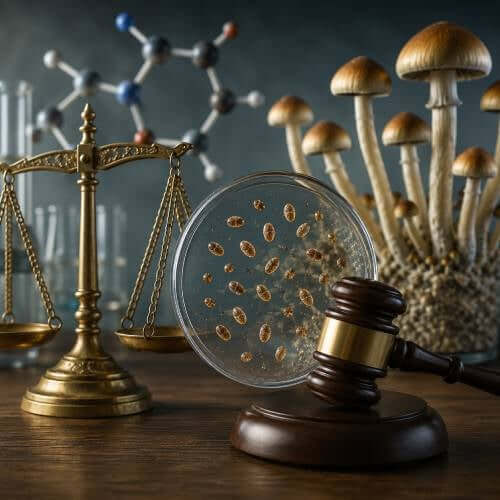
- What Does Federal Law Actually Say About Mushroom Spores?
- Why Do Four States Prohibit Spores When Federal Law Does Not?
- State-by-State Legal Status at a Glance
- What Is the Germination Threshold, and Why Does It Matter?
- How Does Decriminalization Differ From Spore Legality?
- What Should Researchers Look for in a Compliant Spore Vendor?
- FAQs
Quick Answer
Psilocybe cubensis mushroom spores are legal to possess and purchase for microscopy and research in 46 U.S. states. Four states — California, Georgia, Idaho, and Florida — have enacted spore-specific bans. Federally, spores are not scheduled under the Controlled Substances Act because they do not contain psilocybin or psilocin. The moment spores germinate and mycelium begins forming, the legal status changes entirely.
The chemistry is the argument. Psilocybe cubensis spores do not contain psilocybin. Under the federal Controlled Substances Act, it is the compound that is scheduled, not the organism that can eventually produce it. That single distinction is what makes spore research legal across most of the United States, and it is also what makes the legal landscape more nuanced than a one-sentence answer can capture.
This guide covers what federal law actually says, why four states diverge from it, what the germination threshold means in practice, and what researchers and microscopists need to know before purchasing spore syringes or spore prints.
Key Takeaways
- Psilocybe cubensis musroom spores are legal for microscopy and research in 46 U.S. states and D.C. under federal law because they do not contain psilocybin or psilocin.
- Four states — California, Georgia, Idaho, and Florida — have passed their own statutes banning psilocybin-producing mushroom spores. Florida became the most recent addition when HB 651 was signed in 2025.
- The DEA's Drug and Chemical Evaluation Section confirmed in writing in January 2024 that spores lacking psilocybin or psilocin are not controlled substances under the CSA.
- Germination is the legal and biochemical threshold. Once a spore begins developing mycelium, it enters psilocybin biosynthesis and the material becomes a Schedule I controlled substance.
- Decriminalization of psilocybin in certain cities does not change the legal status of spores — spores were already legal for research in those jurisdictions.
- Purchasing from a compliant vendor means verifying their no-ship policy for ban states and confirming research-only labeling and cleanroom production standards.
What Does Federal Law Actually Say About Mushroom Spores?
The Controlled Substances Act (CSA) of 1970 schedules specific chemical compounds. Under Schedule I, the listed psychedelic substances are psilocybin (the prodrug) and psilocin (its active metabolite). Neither Psilocybe cubensis the species, nor fungal spores as a category, appear anywhere in the scheduling language.
This distinction was formally clarified in January 2024, when Terrence Boos, Chief of the DEA's Drug and Chemical Evaluation Section, issued a written confirmation stating that if mushroom spores do not contain psilocybin or psilocin, the material is not considered a controlled substance under the CSA. This was not new policy — it reaffirmed a position the DEA had held for years. But the written confirmation gave vendors, researchers, and legal advisors a concrete, citable reference point.
The logic is straightforward: a dormant basidiospore of Psilocybe cubensis contains no measurable psilocybin. Chromatographic analysis of ungerminated spores consistently returns undetectable levels of the compound. The spore carries genetic instructions, not the controlled alkaloid itself. Under a compound-based scheduling framework, that is a meaningful legal distinction.
Why Do Four States Prohibit Spores When Federal Law Does Not?
States retain the authority to enact stricter laws than federal minimums, and four have done exactly that for psilocybin-producing spores specifically.
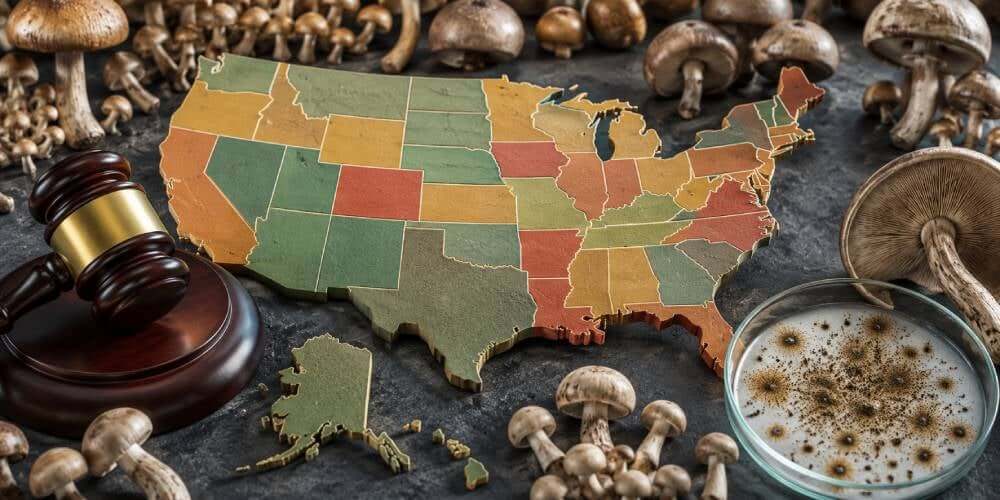
- California — Health and Safety Code Section 11391 prohibits the transport, sale, or transfer of spores or mycelium capable of producing mushrooms that contain a controlled substance. A research exemption exists: spores that are lawfully obtained and used for bona fide research, instruction, or analysis authorized by California's Research Advisory Panel are permitted. For general consumer purchase, however, California vendors typically decline to ship.
- Georgia — Official Code of Georgia Annotated Section 16-13-71 classifies spores capable of producing psilocybin mushrooms as a Schedule I substance. Georgia's law is more sweeping than California's, with no equivalent research exemption for individual buyers.
- Idaho — Idaho Code Section 37-2705 similarly schedules psilocybin-producing spores. Idaho law applies to possession and distribution.
- Florida — The newest addition to this list. Governor Ron DeSantis signed House Bill 651 into law in 2025, extending Florida's controlled substance framework to include spores capable of producing psilocybin mushrooms. Reputable spore vendors began declining Florida orders upon the bill's enactment.
Every established spore vendor, including sporeworks.com, premiumspores.com, inoculatetheworld.com, pnwspore.com, and Magic Spore Labs, maintains a no-ship policy to these four states. Attempting to receive spores in a ban state exposes the buyer to state-level legal risk regardless of federal permissibility.
State-by-State Legal Status at a Glance
The table below reflects the legal status of Psilocybe cubensis spores for microscopy and research purposes as of June 2026. This is not legal advice. Laws change, and local ordinances can differ from state-level statutes. Confirm current laws with a licensed attorney in your state before purchasing.
| State | Spore Status | Notes |
|---|---|---|
| California | Prohibited | H&S Code §11391. Research exemption exists for RAP-authorized work. |
| Georgia | Prohibited | O.C.G.A. §16-13-71. No consumer research exemption. |
| Idaho | Prohibited | Idaho Code §37-2705. Applies to possession and distribution. |
| Florida | Prohibited | HB 651, signed 2025. Most recently banned state. |
| All other 46 states + D.C. | Legal for research | No state-level spore ban. Federal CSA does not schedule spores. Purchase for microscopy, taxonomy, and research is permitted. |
| Oregon | Legal + regulated | Measure 109 legalized supervised psilocybin services. Spores remain legal for research. |
| Colorado | Legal + regulated | Natural Medicine Health Act created a phased framework for supervised psilocybin services. Adults 21+ may possess spores for research. |
What Is the Germination Threshold, and Why Does It Matter?
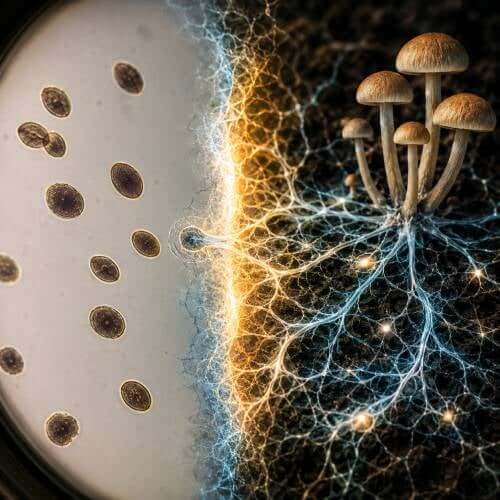
The germination threshold is the legal and biochemical line where spore status changes. A dormant basidiospore of Psilocybe cubensis sits in a metabolically inert state. It carries the fungal genome, but enzymatic activity is suppressed. No psilocybin biosynthesis occurs. This is the state in which mushroom spores are legally purchased and microscopically examined.
When a spore germinates, it activates. The germ tube emerges, hyphae form, and mycelium begins developing. It is during mycelial growth that the biosynthetic pathway for psilocybin becomes active. The enzymes PsiD, PsiK, PsiM, and PsiH work sequentially to convert tryptophan through a series of intermediates into psilocybin, as mapped in detail by researchers Simon Fricke, Janis Fricke, and Dirk Hoffmeister in their 2017 work published in Angewandte Chemie identifying the full biosynthetic gene cluster.
The practical implication: the moment a spore germinates into mycelium, the material transitions from a legally unscheduled research specimen into a psilocybin-producing organism, which is a Schedule I controlled substance under federal law. The research use of mushroom spores, as practiced by microscopists and taxonomists, involves examining spore morphology under a microscope, not germination. That is the activity Magic Spore Labs supports and the activity covered by the legal framework described in this guide.
How Does Decriminalization Differ From Spore Legality?
Several cities and municipalities have decriminalized psilocybin mushrooms to varying degrees, including Denver, Oakland, Santa Cruz, Seattle, Detroit, and Washington D.C. Decriminalization typically means that personal possession of small amounts falls to the lowest enforcement priority — it does not mean the substance is legal, and it does not change the legal status of mushroom spores.
Mushroom spores were already legal for research in those jurisdictions before decriminalization. The decriminalization movement addresses possession and use of mature fruiting bodies containing psilocybin, which remains a Schedule I substance federally. The two legal frameworks operate on separate tracks.
Oregon and Colorado have moved furthest toward a formal regulatory model, licensing supervised psilocybin services under state-run frameworks. As of June 2026, those models address therapeutic access. They do not alter the microscopy-research framework under which spore vendors operate.
What Should Researchers Look for in a Compliant Spore Vendor?
Not all spore vendors handle compliance with the same rigor. For researchers and microscopists who want to purchase legally and responsibly, a few things are worth evaluating:
- Clear no-ship policy for ban states. Any reputable vendor explicitly declines orders to California, Georgia, Idaho, and Florida. If a vendor ships to those states without question, that is a compliance failure regardless of how they label their products.
- Research-only framing on all products. Products should be marketed and labeled for microscopy, taxonomy, and research purposes. No cultivation guidance, no substrate recommendations, no fruiting instructions.
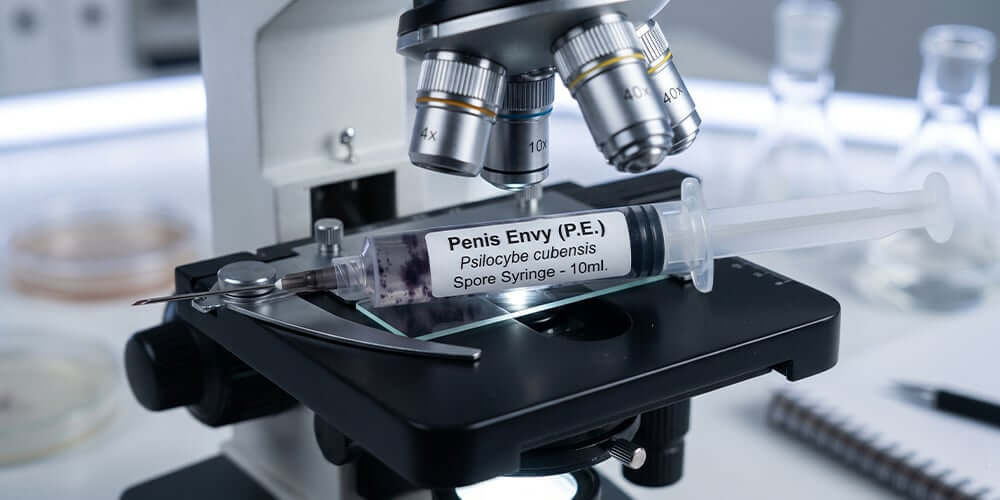
- Sterility and quality standards. Research-grade spore syringes should be produced in a controlled cleanroom environment. Magic Spore Labs produces like the Penis Envy spores all spore syringes in an ISO-certified cleanroom and conducts sterility testing before each shipment.
- Transparent strain labeling. Species designation and strain name should appear clearly. Latin binomials signal a vendor that understands what they are selling from a taxonomic standpoint.
The market for research-grade mushroom spores is small enough that established vendors generally uphold similar standards, because the alternative is legal exposure and customer risk.
Disclaimer: All spores offered by Magic Spore Labs are intended for microscopy, taxonomy, and research purposes only. Spores are not intended for cultivation. It is the customer's responsibility to know and comply with all local, state, and federal laws regarding possession and use of spore products.
FAQs
Are Psilocybe cubensis spores legal under federal law?
Yes. Federal law schedules psilocybin and psilocin as Schedule I controlled substances, not Psilocybe cubensis spores. Because ungerminated spores contain no detectable psilocybin, they fall outside the CSA's scheduling framework. This was formally confirmed by DEA Drug and Chemical Evaluation Section Chief Terrence Boos in January 2024.
Which states have banned mushroom spores?
Four states have enacted spore-specific bans as of 2026: California (H&S Code §11391), Georgia (O.C.G.A. §16-13-71), Idaho (Idaho Code §37-2705), and Florida (HB 651, signed 2025). In all other states, spores are legal to purchase and possess for research and microscopy purposes. Reputable vendors do not ship to these four states.
Why are spores legal if the mushrooms are not?
The Controlled Substances Act schedules specific chemical compounds — psilocybin and psilocin — not the organism that can eventually produce them. A dormant spore contains no psilocybin. It is inert genetic material at the pre-germination stage. The compound only appears once the spore germinates and mycelium begins its biosynthetic activity. Federal scheduling is chemistry-based, not organism-based, which is why the spores fall outside it.
Is it legal to buy mushroom spore syringes online and have them shipped?
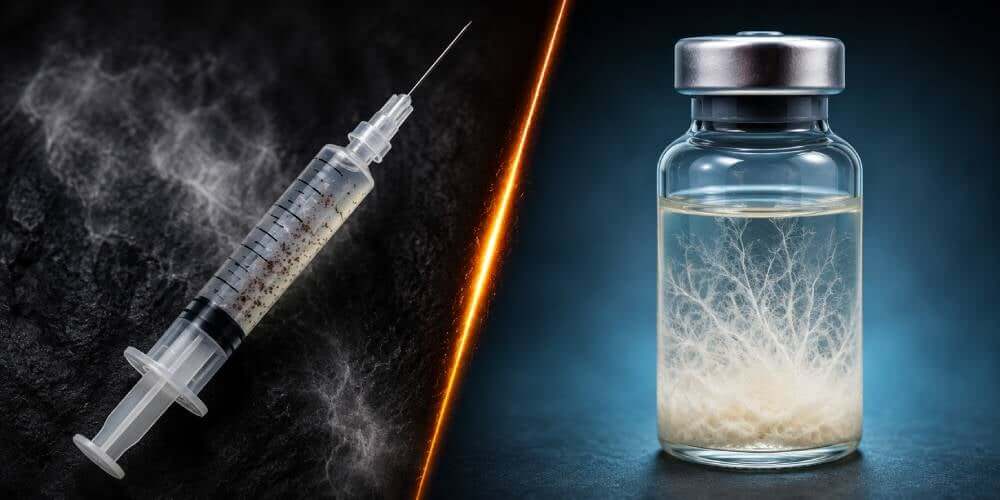
Yes, in 46 states and D.C. Spore syringes labeled for microscopy and research can be purchased from compliant vendors and shipped to all states except California, Georgia, Idaho, and Florida. A spore syringe is a suspension of basidiospores in sterile distilled water, used by microscopists to prepare slides for morphological study. The purchase and receipt of a research-labeled spore syringe in a legal state is lawful.
Does decriminalization of psilocybin affect spore legality?
No. Decriminalization addresses the enforcement priority for possession of psilocybin-containing material, typically mature mushrooms. Spores were already legal for research in those jurisdictions before decriminalization. The two frameworks are independent — decriminalization lowers penalties for the compound; it does not change the pre-existing legal status of the unscheduled spore material.
What happens legally when spores germinate?
Once a Psilocybe cubensis spore germinates and mycelium begins developing, psilocybin biosynthesis activates through the enzymatic pathway encoded in the fungal genome. At that point, the material contains a Schedule I controlled substance and is illegal under federal law. This is the reason spores sold for microscopy are intended to be examined at the pre-germination stage, not grown.
Can I buy mushroom spores in California if I have a research purpose?
Potentially, under specific circumstances. California Health and Safety Code Section 11391 includes an exemption for spores that are lawfully obtained and used for bona fide research, instruction, or analysis that has been authorized by California's Research Advisory Panel. For general consumer purchases without RAP authorization, most compliant vendors decline to ship to California. Consult a licensed California attorney before attempting to import spores for any purpose.