
Table of Contents
- Why Do Spore Syringes Degrade? The Three Mechanisms
- How to Store Spore Syringes: The Correct Setup
- How Long Do Spore Syringes Last?
- How to Handle Spore Syringes Before and After Use
- How to Store Spore Prints for Long-Term Research
- Contamination: What It Looks Like and When to Discard
- Storage Format Comparison: Syringe vs. Print vs. Swab
- Key Takeaways
- FAQs
Store spore syringes refrigerated at 2–8°C (35–46°F), sealed inside an airtight container, away from direct light. Under these conditions, a research-grade Psilocybe cubensis spore syringe will retain viable spores for 12–18 months. The three mechanisms that degrade spore viability are UV-driven photodamage to the spore wall, bacterial and fungal contamination introduced through breached sterility, and osmotic stress from freeze-thaw cycling in the aqueous suspension. Controlling for all three is straightforward with the right storage setup.
A spore syringe is a more resilient research specimen than most people assume — and a more fragile one than most vendors communicate. The dormant basidiospores of Psilocybe cubensis suspended in sterile distilled water are metabolically inert, which confers significant stability. But that stability has specific limits. Push a syringe past those limits and viability drops in ways that are not always visible to the naked eye: the spores look the same in suspension, the water remains clear, and the syringe appears undamaged right up until the slide shows you a population of compromised specimens that will not hold their morphology under examination.
This guide covers what actually happens to spore viability under different storage conditions, the correct setup for refrigerated long-term storage, how to handle syringes before and after use, what contamination looks like and when it is detectable, and how spore prints and swabs differ in their storage requirements. The biology matters here — understanding why these recommendations exist makes it easier to troubleshoot when something goes wrong.
Why Do Spore Syringes Degrade? The Three Mechanisms
Knowing what kills spore viability is more useful than a list of storage rules, because it lets you make informed decisions when your situation does not match the ideal. There are three distinct mechanisms at work.
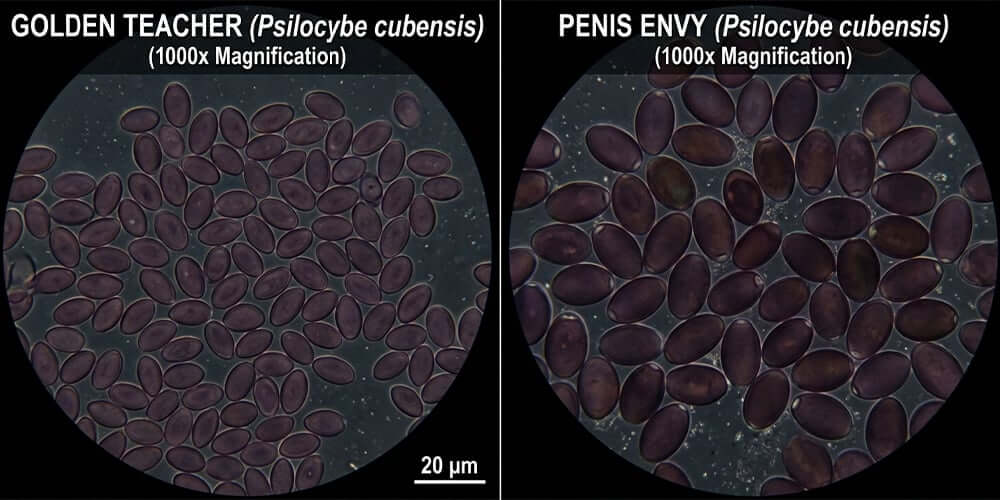
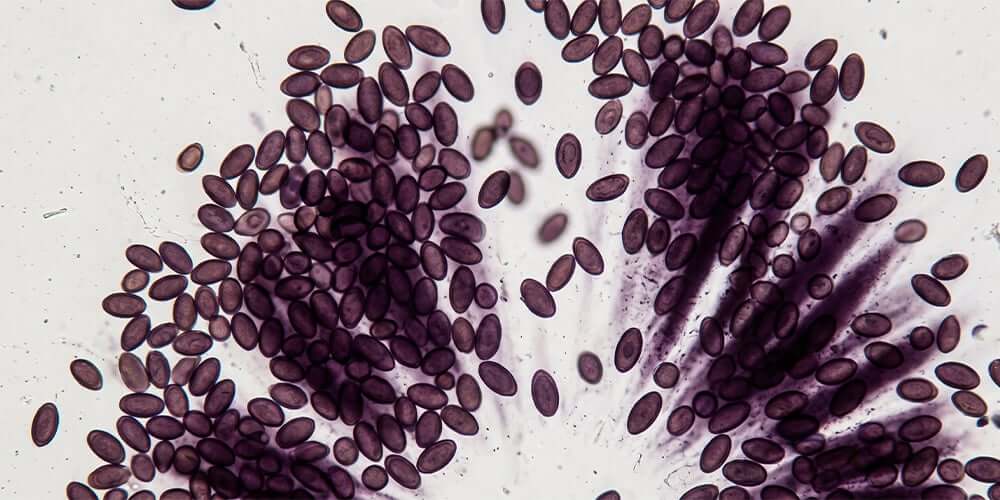
- Photodamage from UV and visible light exposure: Fungal spore walls contain melanin pigments — the same dark purple-brown coloration visible under brightfield microscopy is the spore's primary UV-absorbing barrier. Prolonged exposure to direct sunlight or UV-rich light sources drives photochemical reactions that progressively degrade the spore wall from the outside in. The melanin itself degrades through oxidation, and the underlying structural polysaccharides in the wall become more susceptible to breakdown. This process is cumulative and irreversible. A spore syringe like Penis Envy spore syringe left on a windowsill for a week sustains meaningful viability loss; the same syringe stored in a dark drawer does not.
- Bacterial and fungal contamination: A sealed, sterile syringe fresh from a cleanroom carries no contamination. The contamination threat appears at two points: during production (addressed by the vendor's quality controls) and during use (introduced by the researcher when the needle cap is removed and the syringe is opened to atmosphere). Bacteria present in room air, on skin surfaces, or on non-sterile equipment can enter a syringe within seconds of cap removal. Once inside, bacterial colonies compete for resources in the aqueous medium, produce metabolic byproducts that alter pH and the chemical environment, and can physically adhere to and degrade spore walls. A contaminated syringe may remain visually clear for days before turbidity or discoloration appears — by which point significant spore damage may have already occurred.
- Freeze-thaw cycling and osmotic stress: Spores suspended in distilled water are subject to physical stress when the surrounding aqueous medium undergoes phase changes. During freezing, water forms ice crystals that can penetrate or mechanically disrupt the spore wall at the microscopic level. Slow, repeated freeze-thaw cycles — particularly the kind that happen in a poorly regulated freezer, or in a syringe left in a cold car and then brought back indoors — are more damaging than a single controlled freeze. Distilled water with no cryoprotectant is a poor freezing medium for spore material. For most researchers, the practical takeaway is simple: refrigerate, do not freeze.
Penis Envy Mushroom Spore Syringe
$22.99
$24.99
PE#6 (Penis Envy 6) Mushroom Spore The Penis Envy #6 Mushroom Spore Syringe from Magic Spore Labs delivers basidiospores from the most systematically refined expression of the Penis Envy lineage available in the Psilocybe cubensis research catalog — a sixth-generation… read more

How to Store Spore Syringes: The Correct Setup
Every storage recommendation in this guide follows directly from the three degradation mechanisms above. The setup is simple and requires no specialized equipment beyond a standard refrigerator.
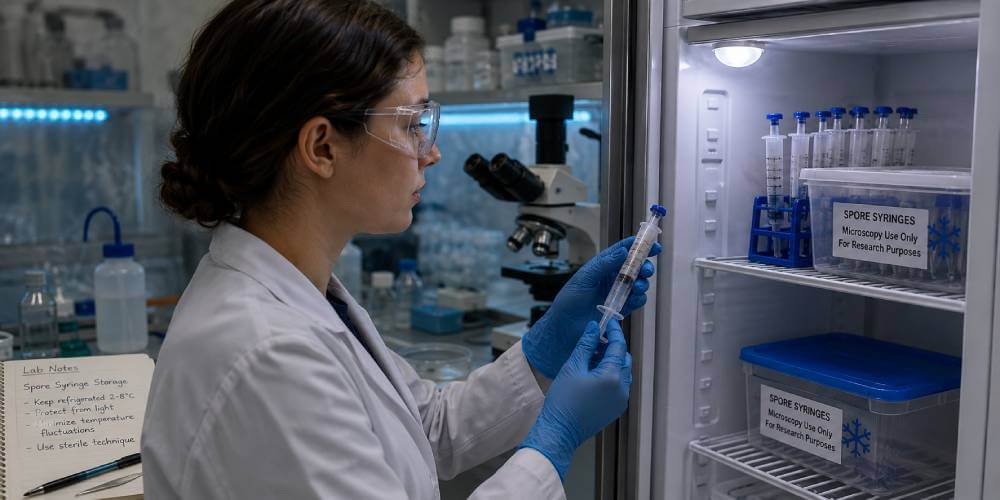
- Temperature: 2–8°C (35–46°F): This is the standard pharmaceutical refrigeration range and the correct target for spore syringe storage. At these temperatures, bacterial metabolic activity is substantially suppressed — most common environmental bacteria have dramatically reduced growth rates below 10°C. Keep syringes in the main body of the refrigerator, not the door — door compartments experience more frequent temperature fluctuations as the refrigerator is opened and closed. Avoid placing syringes near the refrigerator's rear cooling coil, where temperatures may dip below freezing.
- Light: complete darkness: Wrap syringes in aluminum foil if storing them without additional packaging, or place them inside an opaque container. The original packaging from a reputable vendor is typically designed for this — do not discard it before the syringe is used.
- Airtight secondary container: The syringe needle cap provides the primary sterility barrier. A secondary airtight container adds protection against accidental needle cap loosening and humidity fluctuations inside the refrigerator. A clean glass jar with a sealing lid, a vacuum-sealed bag, or a food-grade airtight container all work. Add a food-grade desiccant packet to absorb any residual moisture — particularly useful in humid climates where condensation inside the refrigerator is common.
Taken together, the correct setup is: main refrigerator body at 2–8°C, avoiding door shelves and the rear cooling coil; complete darkness via foil wrap or opaque container; an airtight secondary container such as a glass jar, vacuum bag, or food-grade container with a desiccant packet for humidity control; freezing avoided entirely, since ice crystal formation damages spore walls and the distilled water suspension has no cryoprotection; and original vendor packaging kept intact until the syringe is ready to be opened, since it is sterile at dispatch.

How Long Do Spore Syringes Last?
Under optimal refrigerated storage conditions — 2–8°C, dark, airtight secondary container, original sterile packaging intact — a research-grade Psilocybe cubensis spore syringe from a vendor using ISO-certified cleanroom production retains viable spores for 12 to 18 months. This is the conservative practical range for planning purposes. Some researchers report microscopically viable spore populations from syringes stored for considerably longer, but viability at the margins of the range depends heavily on the quality of the initial production environment and the consistency of storage conditions.
The relevant variable is the quality of production, not just storage. A syringe produced in a non-cleanroom environment with inconsistent sterility testing may begin showing contamination signs at 3–4 months even under ideal storage, because contaminating organisms were introduced at production. Magic Spore Labs produces all spore syringes in an ISO-certified cleanroom with sterility testing on each batch before release — this is the foundation that makes 12–18 month viability realistic rather than theoretical.
Once a syringe is opened — the needle cap removed, a drop expressed, and the cap replaced — the clock resets. Even a few seconds of exposure to ambient air introduces potential contaminants. An opened syringe recapped and returned to refrigerated storage should be used within 30–60 days, with each subsequent use increasing contamination risk. After opening, inspect the suspension closely before each use: turbidity, discoloration, or unusual odor on the needle cap are warning signs to take seriously.
For researchers planning multiple sessions spread over months, ordering individual syringes per session rather than opening one syringe repeatedly is the cleaner approach.
How to Handle Spore Syringes Before and After Use
Storage conditions during active use — the period when a syringe moves from the refrigerator to the microscopy workspace — introduce contamination risks that static storage does not. A few handling practices reduce that risk substantially.
- Allow the syringe to reach room temperature before opening. A cold syringe removed from the refrigerator and immediately opened creates a brief pressure differential as the air inside warms — this can draw ambient air inward when the cap is removed. Letting the syringe sit sealed for 15–20 minutes at room temperature equilibrates the internal pressure before sterility is broken.
- Wipe the needle cap with 70% isopropyl alcohol before removal. Isopropyl alcohol at 70% concentration is the standard surface disinfectant for mycology and laboratory work — higher concentrations (90%+) evaporate too quickly to be effective against bacterial cell walls. Wipe the needle cap exterior thoroughly and allow it to air-dry for 30 seconds before proceeding. This step takes ten seconds and eliminates a significant surface contamination vector.
- Shake vigorously before expressing any liquid. Spores sediment in suspension during refrigerated storage. A syringe that has not been shaken will express concentrated spore aggregates or near-empty distilled water depending on orientation. Shake for 30–60 seconds — vigorous enough to fully redistribute the spore population — before preparing any slide. Examine the expressed drop at 100x before moving to higher magnification to confirm even distribution.
- Express only what you need. For a standard wet mount slide, 10–15 microliters is sufficient. A 10cc syringe contains enough material for hundreds of individual slides when used conservatively.
- Replace the needle cap immediately after use. Cap the syringe between expression and slide preparation, even if the gap is only seconds. Every moment of open exposure adds to cumulative contamination risk over multiple sessions.
How to Store Spore Prints for Long-Term Research
Spore prints have different storage physics than syringes because the spores are dry rather than suspended in water. A dry spore print stored correctly is among the most stable long-term research specimens in mycology — documented cases exist of viable spore prints after a decade or more of proper storage.
The key difference from syringe storage: moisture is the primary threat, not temperature. A dry Psilocybe cubensis spore print exposed to humidity will rehydrate, which activates metabolic processes and can initiate bacterial growth or premature germination in the spore deposit. Keep prints in sealed, dry conditions.
- Allow the print to dry completely before sealing — typically 24–48 hours at room temperature in a clean, low-humidity environment. Sealing a print that still contains surface moisture traps humidity and promotes bacterial growth.
- Place the dried print in a zip-lock bag or sealed envelope with a desiccant packet. Remove as much air as possible before sealing.
- Store in a cool, dark location. A sealed mason jar in a refrigerator drawer is a standard and effective long-term setup.
- Do not freeze spore prints unless using a proper cryostorage protocol. Freeze-thaw cycling causes condensation on the print surface at thaw, introducing moisture into the deposit.
- Label each print with species, strain, collection date, and source before sealing. Prints look nearly identical after months of storage; unlabeled material becomes untrackable.
When ready to prepare a syringe from a stored print, allow the sealed container to reach room temperature before opening to prevent condensation forming on the print surface. Work in a still air environment or under a laminar flow hood. Use a sterile scalpel or inoculation loop to transfer print material into sterile distilled water, and allow the suspension to hydrate for 24 hours before slide preparation.
Contamination: What It Looks Like and When to Discard
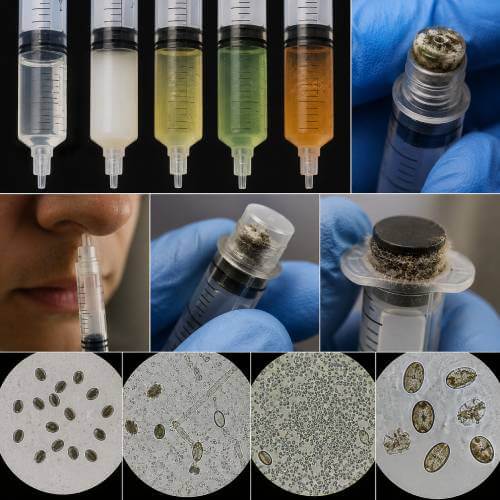
Contamination in spore syringes is not always obvious before slide preparation, which is why knowing the full range of warning signs matters — from the macro-level down to what appears at 400x.
- Turbidity or cloudiness in the suspension: A clean spore syringe contains spores in distilled water. The liquid should appear clear to very slightly hazy when held to light — faint haziness from suspended spores is normal. Visible cloudiness, milky opacity, or flocculent particles floating in the suspension are signs of bacterial or fungal growth. Discard.
- Discoloration: Healthy P. cubensis spore suspensions are clear to very lightly tinted. Green, orange, or yellow tinting indicates microbial contamination. Any color change from the original appearance at purchase warrants discarding the syringe.
- Odor: A sterile spore syringe in distilled water has essentially no smell. Bacterial metabolic activity produces volatile organic compounds detectable as earthy, sour, or pungent notes at the needle cap or in the expressed liquid. Any off-odor is a clear discard signal.
- Visible growth at the needle cap or plunger seal: Fuzzy growth, film formation, or any visible biological material at the syringe extremities means contamination has established a colony. Discard immediately and sterilize the work surface.
- Under the microscope: Early-stage bacterial contamination may not be visible to the naked eye. At 400x or 1000x, bacterial cells appear as small rod-shaped or coccoid bodies, typically 1–5 micrometers in length — far smaller than P. cubensis basidiospores at 11–17 µm. If you observe a dense population of very small, actively motile micro-particles (exhibiting Brownian motion) in the field alongside your spore population, contamination is present. A low level of background particles is normal in all spore suspensions; a high density of motile microparticles is not.
One additional flag beyond active contamination is worth noting: a spore population that shows wall damage or irregular morphology under the microscope, with no other contamination signs present, points instead to possible viability loss from freeze-thaw exposure or age rather than microbial contamination — worth documenting in research records rather than an automatic discard.
Storage Format Comparison: Syringe vs. Print vs. Swab
Spore syringes, spore prints, spore swabs, and liquid cultures each have distinct storage physics, shelf lives, and primary failure modes. The table below summarizes how the formats compare.
| Format | Optimal Temp. | Shelf Life (Proper Storage) | Primary Threat | Secondary Container |
|---|---|---|---|---|
| Spore syringe | 2–8°C | 12–18 months (sealed) | Bacterial contamination; freeze-thaw cycling | Airtight container + desiccant |
| Spore print | Cool, dark; fridge optimal | 5–10+ years (dry, sealed) | Moisture / rehydration; UV exposure | Sealed envelope or zip-lock + desiccant |
| Spore swab | Cool, dark; fridge optimal | 2–5 years (dry, sealed) | Moisture; physical disruption of deposit | Original packaging, resealed; do not re-use after slide prep |
| Liquid culture (gourmet spp.) | 2–8°C | 2–6 months | Ongoing mycelial metabolic activity; contamination | Refrigerated; use before 6 months |
Spore prints consistently outlast syringes in long-term storage because they eliminate the aqueous medium entirely. Dry spores in the absence of moisture have essentially no ongoing degradation pathway beyond UV photodamage. For researchers building a reference collection meant to last years, spore prints stored with desiccant in sealed containers in a dark, cool location are the most durable format available. Syringes offer immediate slide preparation without reconstitution steps — the choice between formats comes down to whether convenience or longevity is the priority for a given research application.
Key Takeaways
- Store spore syringes at 2–8°C in the main body of a household refrigerator, inside an airtight secondary container with a desiccant packet, away from direct light. Do not freeze.
- The three mechanisms that degrade spore viability are UV photodamage to spore wall melanin, bacterial and fungal contamination through breached sterility, and osmotic stress from freeze-thaw cycling in the aqueous suspension.
- A research-grade spore syringe stored correctly retains viable spores for 12–18 months from production. Once opened, reduce that window to 30–60 days and inspect the suspension before each subsequent use.
- Before every use: allow the syringe to reach room temperature while sealed, wipe the needle cap with 70% isopropyl alcohol, and shake vigorously for 30–60 seconds before expressing any liquid.
- Contamination warning signs in order of detectability: off odor at the cap, turbidity or discoloration in the suspension, visible growth at the syringe extremities, and — visible only under the microscope — dense motile micro-particles in the field alongside the spore population.
- Spore prints are the most durable long-term storage format, with viability of 5–10+ years when stored dry and sealed with desiccant. Syringes trade longevity for preparation convenience.
Disclaimer: All spores offered by Magic Spore Labs are intended for microscopy, taxonomy, and research purposes only. Spores are not intended for cultivation. It is the customer's responsibility to know and comply with all local, state, and federal laws regarding possession and use of spore products.
Research-Grade Spore Syringes
Every Magic Spore Labs syringe is produced in an ISO-certified cleanroom with sterility testing on each batch — the production standard that makes 12–18 month refrigerated viability realistic.
Psilocybin SporesWhat Is a Spore?Spore PrintsWhat Are Psilocybin Spores?
Correct storage is the single largest controllable factor in spore syringe viability. Learning how to store spore syringes properly — refrigerated at 2–8°C, dark, airtight, and unopened until use — is what separates a syringe that performs reliably at month fourteen from one that shows contamination at month four. Magic Spore Labs produces every syringe in an ISO-certified cleanroom specifically so that following this storage protocol delivers the full 12–18 month research window.
Disclaimer: All spores offered by Magic Spore Labs are intended for microscopy, taxonomy, and research purposes only. Spores are not intended for cultivation. It is the customer's responsibility to know and comply with all local, state, and federal laws regarding possession and use of spore products.
FAQs
How long do spore syringes last in the refrigerator?
A sealed, research-grade spore syringe stored at 2–8°C in a clean, airtight container away from direct light will retain viable spores for 12–18 months. This assumes the syringe was produced under sterile cleanroom conditions and has not been opened. Once the needle cap is removed and the syringe is opened to atmosphere, the practical window for reliable use shortens to 30–60 days even under continued refrigerated storage.
Can you freeze spore syringes?
No. The aqueous suspension medium contains no cryoprotectant. Ice crystal formation during freezing can penetrate and physically damage spore walls at the microscopic level. Repeated freeze-thaw cycles compound this damage. Refrigeration at 2–8°C is the correct storage temperature — it suppresses bacterial growth without causing the physical stress associated with freezing.
How should I store a spore syringe after opening?
Replace the needle cap immediately after use. Wipe the cap exterior with 70% isopropyl alcohol before recapping. Return the syringe to its airtight secondary container and refrigerate at 2–8°C. Use the opened syringe within 30–60 days and inspect the suspension carefully before each subsequent use — look for turbidity, discoloration, or unusual odor, all of which indicate contamination.
How do I know if my spore syringe is contaminated?
Early-stage contamination may not be visible without a microscope. Macroscopic warning signs include milky or cloudy suspension, unusual coloration (green, orange, or yellow tinting), and off odors at the needle cap. Under a compound microscope at 400x or higher, bacterial contamination appears as a dense population of very small rod-shaped or coccoid particles — 1–5 µm in length — exhibiting active Brownian motion in the field alongside the larger spore population (11–17 µm). Any syringe showing contamination signs should be discarded.
Do spore prints last longer than spore syringes?
Yes, significantly. A spore print stored dry and sealed with a desiccant packet in a cool, dark location can retain viable spores for 5–10 years or more. The absence of an aqueous medium eliminates the bacterial contamination and freeze-thaw risks that limit syringe shelf life to 12–18 months. The trade-off is preparation: slide-ready material requires reconstitution in sterile distilled water before use, adding steps that a pre-made syringe avoids.
What temperature should spore syringes be stored at?
2–8°C, which corresponds to 35–46°F. This is the standard pharmaceutical cold chain range and the correct target for spore syringe storage. It suppresses bacterial metabolic activity effectively without reaching the freezing threshold. Most household refrigerators operate within this range in the main body compartment, though door shelves and proximity to cooling coils should be avoided.
Does light exposure damage spore syringes?
Yes. Fungal spore walls contain melanin pigments that absorb UV and visible light. Prolonged direct light exposure drives photochemical oxidation reactions that progressively degrade these pigments and the underlying spore wall polysaccharides. The damage is cumulative and irreversible. Store syringes in a dark location — the interior of a closed refrigerator satisfies this when syringes are placed in an opaque secondary container.