
Table of Contents
- Key Takeaways
- What Is Psilocybe ovoideocystidiata?
- Spore Morphology on the Slide
- The Namesake: Two Cystidia Classes
- Ovoid vs. Cubensis vs. Cyanescens
- How to Document an Ovoid Slide
- Published Lookalikes at the Microscope
- What This Page Will Not Do
- Legal Status for Spore Research
- Building a Comparison Set
- Sources
- FAQs
Psilocybe ovoideocystidiata Guzmán & Gaines (2007), called ovoid or river teacher in vernacular sources, is a distinct species in family Hymenogastraceae. On a slide, its basidiospores cluster at (7–)8–9(–12) × (5.5–)6–7(–8.5) µm, rhomboid to subrhomboid in face view, with a thick wall and a broad germ pore. The name refers to two classes of ovoid cystidia, not to a Psilocybe cubensis cultivar. This page is a microscopy and taxonomy profile only.
Key Takeaways
- P. ovoideocystidiata is a published species, not a community nickname for a cubensis strain.
- Typical spores are about 8–9 × 6–7 µm. That is shorter and narrower than P. cubensis in Guzmán (typical 13–15 µm long, range (12–)13–15(–17) × 8–10(–11) × 7–9 µm).
- Spore size alone overlaps Psilocybe cyanescens. The diagnostic add-on is the pair of cystidia types, including large globose-pyriform cells.
- The protologue print is violaceous dark. Use print color with measurements, not instead of them.
- Ungerminated spores are for microscopy and identification. Magic Spore Labs does not discuss cultivation and does not ship to California, Georgia, Idaho, or Florida.
Taxonomy
What Is Psilocybe ovoideocystidiata?
Psilocybe ovoideocystidiata is a blueing Psilocybe species described in 2007 by Gastón Guzmán, Richard V. Gaines, and Florencia Ramírez-Guillén in the International Journal of Medicinal Mushrooms. The binomial authority is Guzmán & Gaines. The holotype is Gaines 51b (XAL), collected 5 June 2005 at Evansburg State Park, Montgomery County, Pennsylvania, on wood or wood debris in deciduous forest. Index Fungorum records the name as IF 530371.
Guzmán placed the species in section Stuntzii for three published characters: subrhomboid thick-walled spores, a caerulescent basidioma, and an annulus. Those are taxonomic characters from the protologue — not grow instructions.
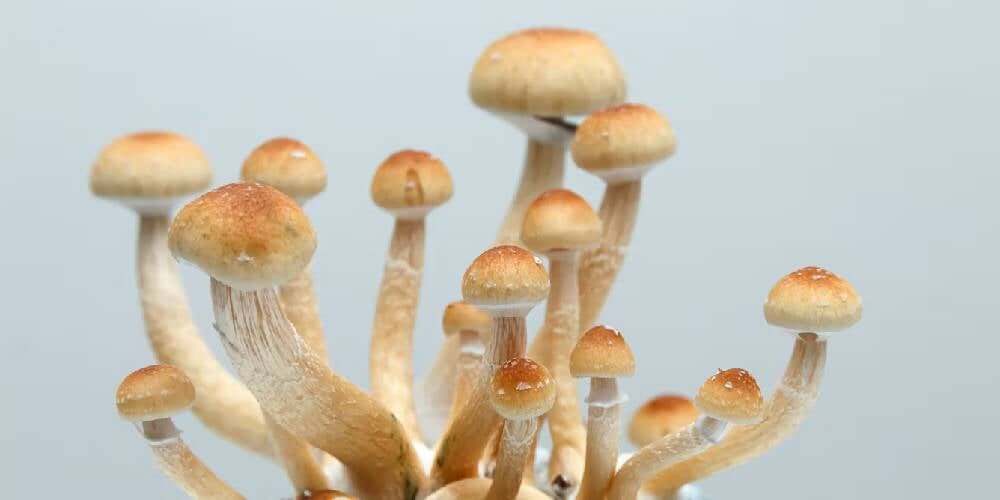
Ovoid and river teacher do not appear in the protologue. They are vernacular labels used on Wikipedia, EOL, and GBIF. File the voucher under the binomial.
This is not a Psilocybe cubensis strain. Cubensis cultivars (Golden Teacher, Penis Envy, and the rest of a typical vendor list) share one species-level spore profile. Ovoid does not. If a slide is labeled "ovoid" and the spores measure like cubensis, the label is wrong or the sample is mixed. For the cubensis baseline, see What Is Psilocybe Cubensis.
Published record, at a glance: Binomial Psilocybe ovoideocystidiata Guzmán & Gaines (2007), family Hymenogastraceae, section Stuntzii. Holotype XAL, Gaines 51b, Pennsylvania. Index Fungorum record 530371. Etymology from the frequent ovoid pleurocystidia and cheilocystidia. Spore print violaceous dark (Guzmán et al. 2007). GBIF lists the species as taxon 5459336; iNaturalist and Mushroom Observer hold field records, useful for range notes but not a substitute for a measured slide.
Microscopy
Spore Morphology on the Slide
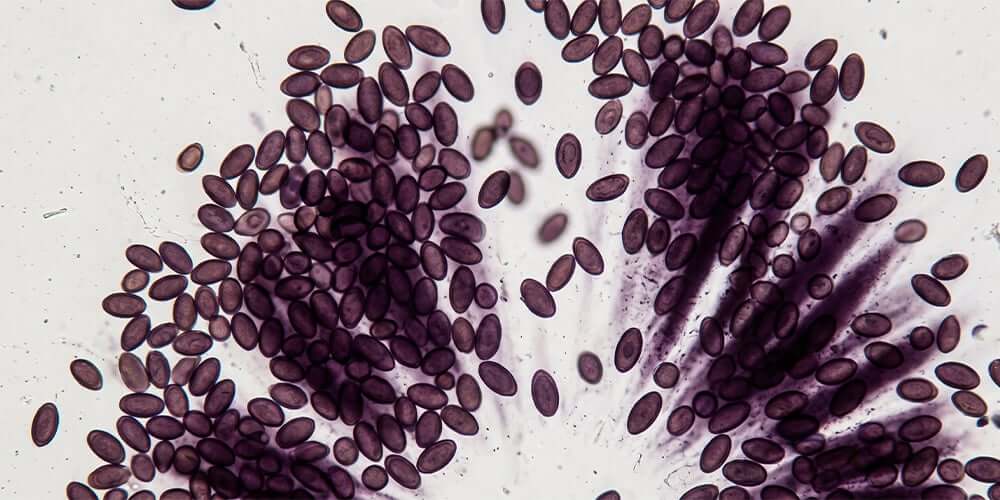
The protologue gives a tight, usable range. Spores are (7–)8–9(–12) × (5.5–)6–7(–8.5) µm. Face view is rhomboid or subrhomboid. Side view is subellipsoid. The wall is thick, 0.8–1.5 µm, and yellowish brown under the mount. One pole has a broad germ pore. The other has a short hilar appendage. Basidia are 20–28 × 7–9 µm and typically 4-spored.
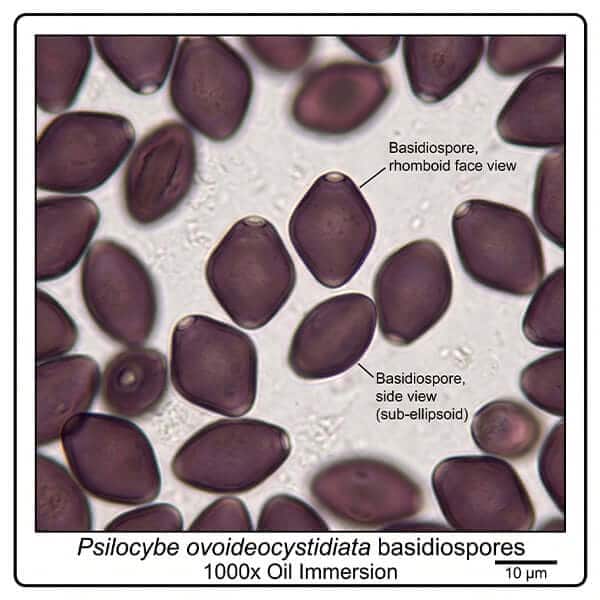
That shape is the first filter. Guzmán's cubensis spores are subhexagonal in face view and subellipsoid in side view. Ovoid spores are rhomboid or subrhomboid in face view. If you only record length and skip face-view shape, you throw away the character Guzmán used to place the species in Stuntzii.
Work at 400× to find a clean field, then measure at 1000× oil immersion on a calibrated ocular micrometer. Measure at least 20 spores, length and width, and note face view versus side view.
Morphology
The Namesake: Two Cystidia Classes
The epithet is the ID key. Guzmán described two types of pleurocystidia and two types of cheilocystidia. Pleurocystidia type a measure 16–24(–35) × 6–8(–10) µm, hyaline and ventricose-rostrate. Pleurocystidia type b measure 20–30(–40) × (10–)12–16(–20) µm, pale brownish gray, globose-pyriform, sometimes with a narrow or moniliform apex. Cheilocystidia type a share the outline of pleurocystidia type a at 18–22 × 5–9(–11) µm. Cheilocystidia type b are 25–29 × 9–13 µm, globose, pedunculate or subpedunculate, hyaline or with irregular bluing contents. Type b is the ovoid cell the name points at.
If a mount shows only flask-shaped cheilocystidia and no large globose-pyriform cystidia, do not force an ovoid determination from spore size alone.
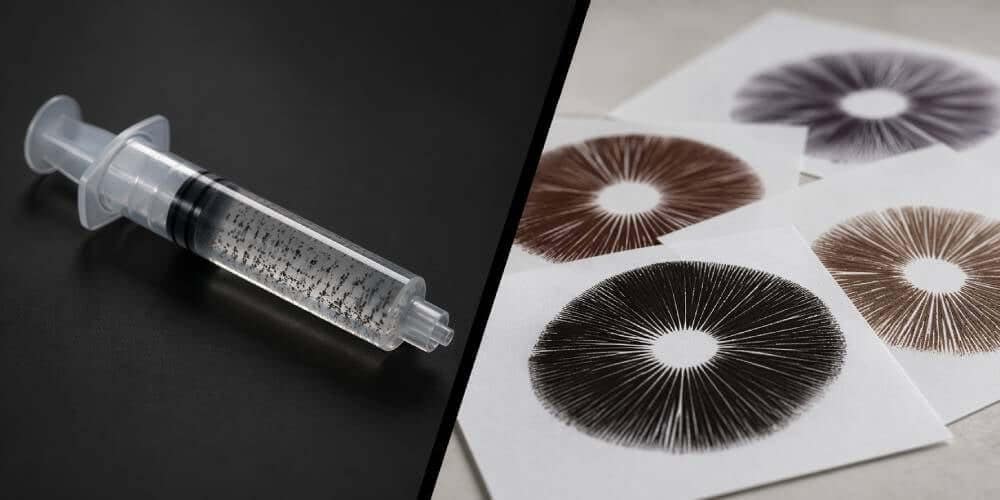
Cystidia require a hymenium mount: a gill edge or gill face, not a spore-only syringe drop. A spore syringe is the right tool for spore metrics — it will not show the namesake cells. If you only have spores, report spore data and stop. Do not upgrade the ID to species on spores plus a vendor label.
Species Comparison
Ovoid vs. Cubensis vs. Cyanescens
This table compiles published ranges — it is not a new lab series. The useful fact is the gap pattern: ovoid is clearly smaller than cubensis, and only partly overlapping with cyanescens.
| Character | P. ovoideocystidiata | P. cubensis | P. cyanescens |
|---|---|---|---|
| Spore size (µm) | (7–)8–9(–12) × (5.5–)6–7(–8.5) | (12–)13–15(–17) × 8–10(–11) × 7–9 | 9–12 × 5–8 (Stamets 1996, widely cited) |
| Face-view shape | Rhomboid to subrhomboid | Subhexagonal | Elliptic / elongate-elliptic |
| Wall | 0.8–1.5 µm, thick | Thick-walled (Guzmán) | Guzmán figures for cyanescens are thinner (0.1–0.5 µm); do not mix wall numbers across papers |
| Germ pore | Broad, one pole | Present, truncate | Broad, distinct |
| Cystidia note | Two classes, including large globose-pyriform | Present; not this two-class ovoid set | North American collections: clavate-mucronate pleurocystidia |
| Print color | Violaceous dark | Dark purple-brown to blackish (MSL cubensis profile) | Dark purple-brown in secondary accounts |
| Sources | Guzmán et al. 2007 | Guzmán 1983, restated in Guzmán et al. 2012 | Stamets 1996 as cited in species accounts |
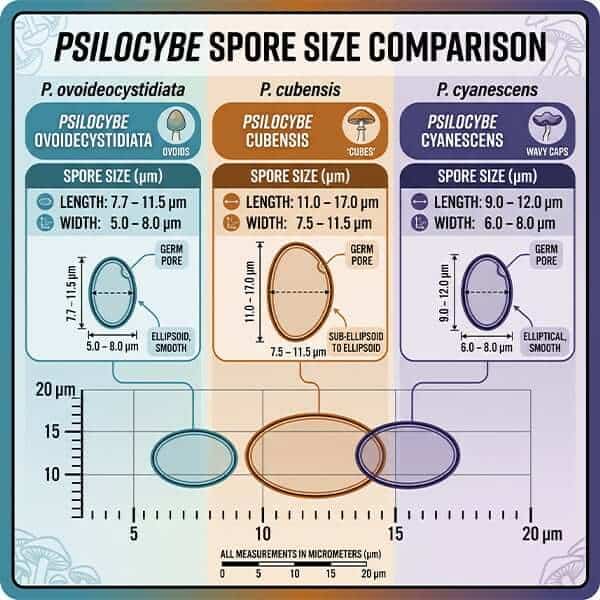
Compiled fact you can quote: a 20-spore mean that follows the Guzmán ovoid cluster should sit near 8–9 × 6–7 µm. The same protocol on P. cubensis, using Guzmán's cubensis range, should sit at 13–15 µm in length. Those typical clusters barely overlap. That length gap is larger than ordinary calibration error at 1000× oil. P. cyanescens is the closer problem: 9–12 µm overlaps ovoid's upper end, so use rhomboid face view plus the two cystidia classes, not length alone.
Protocol
How to Document an Ovoid Slide
- Record the sample ID, date, mount medium (water or 5% KOH, matching the protologue), and magnification.
- Photograph a face-view field and a side-view field at 1000×.
- Measure 20 spores. Report range, mean, and n. Separate face-view and side-view notes.
- Score wall thickness and germ-pore presence. Do not guess wall thickness if the mount is washed out.
- If you have gill tissue, hunt for both cystidia classes and photograph type b.
- Compare the numbers to the comparison table above before you write a species name on the card.
KOH and NH4OH were the mountants in the original description. Congo red was used as a stain. Those are microscopy reagents, not production steps.
Identification
Published Lookalikes at the Microscope
Field notes often mix ovoid with Psilocybe caerulipes. On a slide, the clean published difference is spore width plus cystidia. Singer and Smith (1958), as quoted in later species accounts, give P. caerulipes ellipsoid spores 7–10 × 4–5 µm, no pleurocystidia, and lageniform cheilocystidia. Ovoid spores are (5.5–)6–7(–8.5) µm wide, rhomboid in face view, with two cystidia classes including globose-pyriform type b. If width sits at 4–5 µm and pleurocystidia are absent, do not force an ovoid name.
The 2007 paper does not compare ovoid to cubensis, cyanescens, or caerulipes. Its closest published relatives are Asian section Stuntzii taxa (P. subaeruginascens, P. septentrionalis, P. wayanadensis). Guzmán separated ovoid from those three by the two types of wide pleurocystidia and cheilocystidia.
Brown-spored genera such as Agrocybe can look similar in a photograph. They lack the blueing reaction of a psilocybin-containing Psilocybe and they do not share this spore-and-cystidia set. A print plus a measured slide still beats a guess from cap color.
Scope
What This Page Will Not Do
It will not tell you where to walk, what wood chips to inspect, or how to produce fruiting bodies. The protologue ecology is gregarious on wood or wood debris, in trails or places with herbaceous plants, in a deciduous forest, known in 2007 only from the Pennsylvania type locality. Later range maps on Wikipedia and GBIF are not used as primary sources here. Effects, potency, and cultivation are out of scope for Magic Spore Labs.
Legal
Legal Status for Spore Research
Psilocybin and psilocin are Schedule I under 21 U.S.C. § 812. Spores are not named in that list. A 2 January 2024 DEA letter from Terrence L. Boos states that material is not controlled under the CSA if it does not contain psilocybin or psilocin, and that it becomes controlled if those compounds appear (for example, upon germination).
Shipping restriction: Magic Spore Labs does not ship to California, Georgia, Idaho, or Florida. This is not legal advice — check current law before you order.
Reference Slides
Building a Comparison Set
If you are learning this ID, keep a cubensis reference slide next to the unknown. A Golden Teacher spore syringe is the clean cubensis control: same genus, much larger spores, subellipsoid outline. Dry prints in the spore print collection are the better format for print-color notes and long-term voucher storage. More cubensis syringes are in the liquid spore collection.
Sources
- Guzmán, G., Gaines, R.V., and Ramírez-Guillén, F. (2007). New Species of Hallucinogenic Psilocybe (Fr.) P. Kumm. (Agaricomycetideae) from the Eastern U.S.A. International Journal of Medicinal Mushrooms 9(1): 75–77. doi:10.1615/IntJMedMushr.v9.i1.90
- Species Fungorum / Index Fungorum. Psilocybe ovoideocystidiata Guzmán & Gaines, record 530371.
- GBIF Secretariat. Psilocybe ovoideocystidiata Guzmán & Gaines, taxon 5459336.
- Wikipedia contributors. Psilocybe ovoideocystidiata. Print color, common names, and secondary summary of the protologue.
- Guzmán, G., et al. (2012). Psilocybe s.s. in Thailand: four new species and a review of previously recorded species. Restates Guzmán 1983 cubensis spores (12–)13–15(–17) × 8–10(–11) × 7–9 µm.
- Ramírez-Cruz, V., et al. (2013). Phylogenetic inference and trait evolution of the psychedelic mushroom genus Psilocybe sensu lato (Agaricales). Botany 91: 573–591. doi:10.1139/cjb-2013-0070
- Stamets, P. (1996). Psilocybin Mushrooms of the World. Ten Speed Press. Cited in species accounts for P. cyanescens spores 9–12 × 5–8 µm.
- Boos, T.L., DEA Drug and Chemical Evaluation Section. Letter of 2 January 2024 on the control status of mushroom spores under the CSA.
- Magic Spore Labs. Are Mushroom Spores Legal? A State-by-State Guide.
Kyle Wilson writes microscopy and taxonomy notes for Magic Spore Labs. This profile stays on published characters: spore metrics, cystidia classes, and slide-level separation from P. cubensis and P. cyanescens.
Research use only: Our Psilocybe Cubensis spores are intended for microscopic research and identification purposes only. They are not for human consumption. We will not answer questions about cultivation. Any communication that implies the intent to harvest or cultivate Psilocybe Cubensis (Magic) Mushrooms will result in the cancellation and refund of your order. Additionally, future attempts to purchase from us will be denied. We do not ship to California, Georgia, Idaho, or Florida.
This Psilocybe ovoideocystidiata profile stays on published, citable characters — spore metrics, cystidia classes, and the taxonomic checks that separate it from Psilocybe cubensis and Psilocybe cyanescens on the slide. Magic Spore Labs prepares ovoid spore materials strictly for microscopy and taxonomy research, consistent with the published record cited throughout this profile.
FAQs
What is Psilocybe ovoideocystidiata?
Psilocybe ovoideocystidiata is a distinct Psilocybe species described in 2007 by Guzmán, Gaines, and Ramírez-Guillén, placed in section Stuntzii within family Hymenogastraceae. It is not a strain or cultivar of Psilocybe cubensis — it is a separately published binomial with its own holotype (Gaines 51b, Pennsylvania) and Index Fungorum record (530371). Under a microscope, it's identified by rhomboid to subrhomboid basidiospores measuring roughly 8–9 × 6–7 µm and two distinct classes of pleurocystidia and cheilocystidia.
How should Psilocybe ovoideocystidiata spore samples be stored for microscopy?
Spore syringes should be kept refrigerated at 2–8°C (35–46°F) and away from light, which preserves viability for slide preparation for up to 12 months. Spore prints store best as dry vouchers in a sealed, light-protected envelope at room temperature or refrigerated for longer-term reference. Proper storage matters most for maintaining clean morphology for measurement — degraded samples can distort spore dimensions under the microscope.
Does Magic Spore Labs ship Psilocybe ovoideocystidiata spores to my state?
Magic Spore Labs ships to all U.S. states except California, Idaho, Florida, and Georgia. These four states currently restrict mushroom spore products regardless of species. Check current state law before ordering, since regulations can change.
What is the difference between Psilocybe ovoideocystidiata and Psilocybe cubensis?
They are entirely separate species, not strains of the same organism. Psilocybe ovoideocystidiata has smaller basidiospores (roughly 8–9 × 6–7 µm, rhomboid in face view) compared to Psilocybe cubensis (roughly 13–15 µm long, subhexagonal in face view), and it belongs to a different taxonomic section. A slide labeled "ovoid" that measures like cubensis indicates a mislabeled or mixed sample.
Why is Psilocybe ovoideocystidiata sometimes called "river teacher"?
River teacher and ovoid are vernacular nicknames that appear on sites like Wikipedia, EOL, and GBIF, not names used in the original 2007 scientific description. The species' actual epithet, ovoideocystidiata, refers to its two classes of ovoid-shaped cystidia — the diagnostic cells found in the gill tissue. For accurate recordkeeping, vouchers and slides should be filed under the published binomial rather than the common name.