
Table of Contents
- Key Takeaways
- What Is the Definition of Mycology?
- How Does Research Mycology Differ From Encyclopedia Mycology?
- What Are the Major Groups of Fungi?
- How Do Mycologists Do Spore Taxonomy on a Slide?
- Where Does Psilocybe cubensis Sit in Fungal Taxonomy?
- How Is Mycology Different From Microbiology and Botany?
- Sources
- FAQs
A microscopy definition of the science, then how spore taxonomy is done on a slide.
Mycology is the scientific study of fungi: their classification, genetics, chemistry, ecology, and the microscopic characters used to name species. For microscopy researchers, that work happens on a slide, where spore size, shape, wall, color, and germ pores become taxonomic evidence. This page covers the mycology definition and the slide-level method encyclopedia entries skip.
Royal Botanic Gardens, Kew counted 144,000 named fungal species in its 2018 State of the World's Fungi report, and still put the global total between 2.2 and 3.8 million. Most of Kingdom Fungi is unnamed. Mycology is the science that names it. For researchers who buy spores to study under a microscope, the practical unit of that science is a calibrated measurement, not a dictionary line.
Wikipedia and Britannica own the encyclopedia slot for "what is mycology." They define the field, then wander into food, medicine, plant disease, and history. This guide stays with the definition microscopy researchers actually use, then shows how spore taxonomy is recorded on a slide.
Key TakeawaysKey Takeaways
- Mycology is the branch of biology that studies fungi as their own kingdom, not as a subset of plants.
- The mycology definition used in research is operational: name the fungus, score its microscopic characters, and check that name in Index Fungorum or MycoBank.
- Kew's 2018 report listed 144,000 named fungal species against an estimated 2.2 to 3.8 million on Earth, a gap encyclopedia pages on this query do not cite.
- Spore taxonomy on a slide rests on size range in microns, shape, wall, ornamentation, deposit color, and germ-pore presence.
- Psilocybe cubensis (Earle) Singer is the current name in Index Fungorum (record 290107), with Stropharia cubensis Earle 1906 as the basionym.
- Magic Spore Labs sells spores for microscopy, taxonomy, and research only. Four U.S. states currently block shipment: California, Georgia, Idaho, and Florida.
Definition
What Is the Definition of Mycology?
Mycology is the scientific study of fungi, including mushrooms, yeasts, moulds, lichens, rusts, and smuts. The word joins the Greek mukēs (fungus) with -logia (study). A mycologist is the person who does that work.
Kew's 2018 report states the definition in laboratory terms. Fungi digest food outside their cells, store reserves as glycogen and lipids rather than starch, and build cell walls primarily of chitin, the same polymer found in insect exoskeletons. Those characters, plus DNA, place fungi in an independent kingdom closer to animals than to plants. R.H. Whittaker formalized that kingdom split in Science in 1969.
The mycology definition searchers type into Google is the same question. Mycology is not "mushrooms as food" and it is not a medical specialty by default. It is the discipline that classifies fungi, maps their genetics, and, for microscopy researchers, scores the characters visible at 400x to 1000x.
Research vs. Encyclopedia
How Does Research Mycology Differ From Encyclopedia Mycology?
Encyclopedia mycology explains the kingdom. Research mycology names a specimen. The first answers "what are fungi." The second answers "what is this spore on this slide, and what is its current scientific name."
Kew estimated that more than 93% of fungal species remain unknown to science. That gap is why microscopy still matters. DNA can split lookalikes that share a shape. A slide still supplies the morphological characters keys, monographs, and databases expect: length, width, Q ratio, wall, pore, ornamentation, and color in deposit.
Index Fungorum and MycoBank are the working name registries. A researcher who measures Psilocybe cubensis spores and then looks up the current name is doing mycology. A reader who stops at "study of fungi" is reading an encyclopedia.
| Question | Encyclopedia mycology | Research and microscopy mycology |
|---|---|---|
| Core job | Define Kingdom Fungi for a general reader | Identify and name a specimen from characters you can score |
| Typical sources | Survey articles, textbooks, museum explainers | Index Fungorum, MycoBank, peer-reviewed monographs, calibrated slides |
| Unit of evidence | Kingdom, phylum, ecology, human uses | Spore size in µm, shape, wall, germ pore, deposit color, Latin binomial |
| Name handling | Common names and a short history of the field | Current name, basionym, family, registration identifier |
| What "what is mycology" pages usually skip | Nothing at the survey level | How a researcher actually separates species on a slide |
Classification
What Are the Major Groups of Fungi?
Kew's 2018 fungal tree recognizes eight phyla, not the four types older textbooks listed. People Also Ask still asks "What are the 4 types of fungi?" The four-type list was chytrids, zygomycetes, ascomycetes, and basidiomycetes.
Those eight are Cryptomycota, Microsporidia, Chytridiomycota, Blastocladiomycota, Zoopagomycota, Mucoromycota, Ascomycota, and Basidiomycota. Kew put roughly 90,000 described species in Ascomycota and 50,000 in Basidiomycota. Index Fungorum logged 2,189 new species in 2017, 68% of them ascomycetes and 31% basidiomycetes.
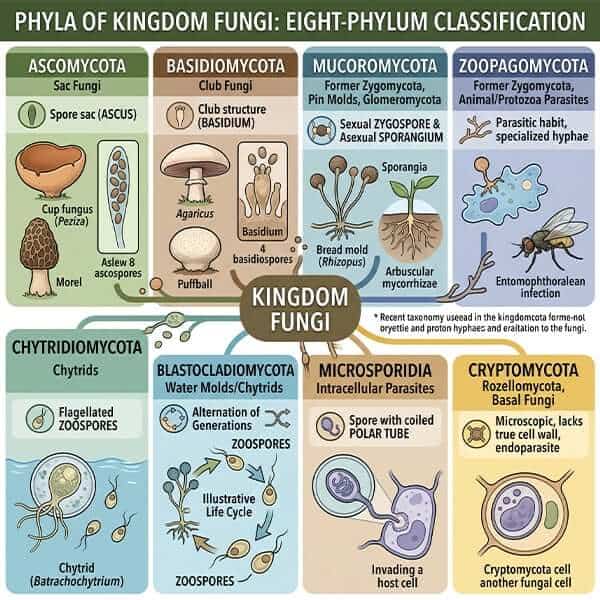
Microscopy researchers who study mushroom spores work almost entirely in Basidiomycota, the phylum that produces basidiospores on basidia. Ascomycota covers yeasts, many moulds, cup fungi, and most lichens. The other six phyla are real fungi. They rarely appear on a Psilocybe slide.
Family counts move fast. Kew recorded 536 accepted fungal families in 2007 and 886 a decade later. DNA keeps splitting groups that looked identical under a hand lens. Spore characters still have to match the name you publish or file.
Microscopy Method
How Do Mycologists Do Spore Taxonomy on a Slide?
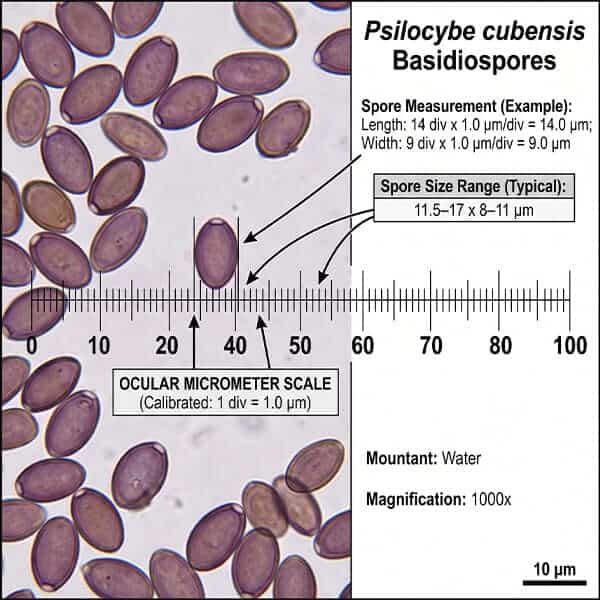
Mycologists do spore taxonomy by scoring size, shape, wall, ornamentation, germ pores, and deposit color on a calibrated slide. They mount a sparse sample, find isolated spores, and record the same traits identification keys have used since Pier Andrea Saccardo sorted fungi by spore color and form in the Sylloge Fungorum.
Size (Length & Width)
Measured in microns on a calibrated ocular micrometer, then used to compute Q (length divided by width). A diagnosis quotes a range across 20 or more spores, not one "perfect" spore.
Shape & Orientation
Scored as globose, subglobose, ellipsoid, subellipsoid, amygdaliform, citriform, or cylindrical. A spore can look oval in face view and flattened in profile — focus through it and note both views.
Wall, Ornamentation & Germ Pore
Thick versus thin walls change the outline; smooth versus warted, ridged, or reticulate surfaces separate genera. An apical germ pore, a truncate end, or the absence of a pore often keeps two similar dark-spored mushrooms apart.
Deposit Color
The print color, not a lighting artifact on one spore, belongs in the same notes as the other characters and is checked alongside size, shape, wall, and germ pore.
Those characters are why species ID through microscopy treats spores as diagnostic structures rather than decoration. They are also why a clean, labeled syringe or print is a research tool: you need intact walls and visible pores, not debris.
Case Study
Where Does Psilocybe cubensis Sit in Fungal Taxonomy?
Psilocybe cubensis (Earle) Singer is a named basidiomycete, not a marketing nickname. Index Fungorum record 290107 lists the current name as published by Rolf Singer in Sydowia 2: 37 (1948). The basionym is Stropharia cubensis Earle 1906. That is the nomenclatural spine every microscopy note on this species should cite.
On the slide, researchers score P. cubensis basidiospores as dark, smooth, and subellipsoid, with a distinct apical germ pore. Those qualitative characters match what you will see in a well-prepared mount. They do not replace a measured range from your own calibrated optics. Compare your notes with the species profile of Psilocybe Cubensis and with the current name in Index Fungorum or MycoBank before you treat a strain label as a taxon.
Strain names such as Golden Teacher are microscopy catalog labels inside P. cubensis. They are not separate Latin binomials. The species is the unit Index Fungorum registers. The strain is the sample lot you put on the slide.
Research-Grade Psilocybe cubensis Spores
Browse research-grade Psilocybe cubensis spores for microscopy when you need labeled, lab-checked material for comparison work.
Related Fields
How Is Mycology Different From Microbiology and Botany?
Mycology studies fungi. Microbiology studies microscopic organisms across several kingdoms. Botany studies plants. The three overlap in labs and course catalogs, which is why the terms get mixed in search.
Fungi were housed in botany for centuries because mushrooms look like plants and Linnaeus placed them in Species Plantarum. Kew notes that Linnaeus gave fungi fewer than fifty of that book's 1,200 pages. Whittaker's 1969 kingdom system, and the DNA that followed, pulled fungi out. Many universities still teach mycology inside a plant-science department. The organisms are not plants. Their walls are chitin. They do not photosynthesize.
Microbiology includes fungi when the fungus is a yeast, a mould, or a pathogen grown in culture collections. It also includes bacteria, archaea, protozoa, and viruses. A mycologist can be a microbiologist. A microbiologist is not automatically a mycologist. Spore taxonomy of gilled mushrooms is mycology even when the tool is a microscope.
In short: mycology's primary home for microscopy spore characters is Kingdom Fungi taxonomy, genetics, ecology, and chemistry, where those characters serve as standard taxonomic evidence. Microbiology overlaps for yeasts and moulds grown in culture but does not own mushroom spore taxonomy. Botany is the field's historical home — fungi were classified by habit alongside plants for centuries — even though fungi are not plants.
Sources
- Willis K.J. (ed.). State of the World's Fungi 2018. Royal Botanic Gardens, Kew. Named-species count (144,000), diversity estimate (2.2 to 3.8 million), eight-phylum tree, 2017 Index Fungorum intake (2,189 species), and the chitin-wall / animal-affinity definition of fungi.
- Hawksworth D.L., Lücking R. (2017). Fungal Diversity Revisited: 2.2 to 3.8 Million Species. Microbiology Spectrum 5(4). FUNK-0052-2016. Primary source for the diversity range Kew cites.
- Whittaker R.H. (1969). New concepts of kingdoms of organisms. Science 163(3863): 150-160. Fungi as an independent kingdom.
- Index Fungorum. Psilocybe cubensis (Earle) Singer, Sydowia 2(1-6): 37 (1948). Record ID 290107. Current name, basionym Stropharia cubensis Earle 1906.
- Singer R. (1948). Sydowia 2: 37. Nomenclatural transfer of Earle's species into Psilocybe.
- Earle F.S. (1906). Stropharia cubensis. Información Anual de la Estación Central Agronómica de Cuba 1: 240. Basionym.
- Saccardo P.A. (1882- ). Sylloge Fungorum. Historical spore-color and spore-form classification used before DNA sequencing.
Blake Brown writes microscopy and taxonomy research guides for Magic Spore Labs.
Research use only: All spores offered by Magic Spore Labs are intended for microscopy, taxonomy, and research purposes only. Spores are not intended for cultivation. It is the customer's responsibility to know and comply with all local, state, and federal laws regarding possession and use of spore products.
Mycology is the discipline that gives spore taxonomy its structure — from Kingdom Fungi's eight phyla down to the calibrated slide where size, shape, wall, and germ pore separate one species from another. Magic Spore Labs supports that research-mycology work with labeled Psilocybe cubensis material prepared strictly for microscopy and taxonomy study.
FAQs
What is the definition of mycology?
Mycology is the scientific study of fungi, including mushrooms, yeasts, moulds, lichens, rusts, and smuts. Researchers use that definition as a working brief: classify the organism, record its microscopic characters, and keep the name current in Index Fungorum or MycoBank. Encyclopedia entries add food, medicine, and plant disease, but the core definition doesn't require those extras.
How should spore samples be stored for mycology research?
Spore syringes should be kept refrigerated at 2–8°C (35–46°F) and away from light, which preserves viability for slide preparation for up to 12 months. Spore prints store best as dry vouchers in a sealed, light-protected envelope, either at room temperature or refrigerated for longer-term reference. Consistent storage conditions matter because degraded samples can distort the spore measurements researchers rely on for taxonomy.
Are mushroom spores legal to study in the United States?
In most states, ungerminated spores sold for microscopy and taxonomy are legal to possess for research. California, Georgia, Idaho, and Florida currently restrict psilocybin-producing mushroom spores, and Magic Spore Labs does not ship to those four states. Federal scheduling targets psilocybin and psilocin as compounds, not dormant spores that lack those compounds. Confirm your own state statutes before you order.
Is mycology the same as microbiology?
No. Mycology is the study of fungi specifically, while microbiology is the study of microscopic organisms across several kingdoms, including bacteria, archaea, and viruses. Yeasts and moulds sit in both conversations, so a mycologist can also be a microbiologist, but a microbiologist isn't automatically a mycologist. Identifying a dark-spored mushroom from basidiospores on a slide is a mycology problem even though the tool used is microscopic.
Do strain names like Golden Teacher count as separate species?
No. Golden Teacher is a catalog strain inside Psilocybe cubensis (Earle) Singer, not a separate Latin binomial. Index Fungorum registers the species — record 290107 — while the strain name functions as sample metadata that keeps different lots comparable on the slide. Researchers should record the binomial in their notes and treat the strain name as a label for the specific sample, not a taxonomic identity.