
Table of Contents
Psilocybe ochraceocentrata C. Sharp, A. Bradshaw, B. Dentinger & B. van der Merwe (2026) is the African sister species to Psilocybe cubensis. Holotype spores (BUL 8013) measure (10–)11–11.8–12.5(–12.5) × 6.5–7.6–8 µm in side view (n=30), with Q = 1.44–1.55–1.71. This page is taxonomy and spore morphology only.
Key Takeaways
- P. ochraceocentrata is a 2026 species name for African material long treated as cubensis-like or natalensis-like on vendor labels.
- Holotype spores sit near a side-view mean of about 11.8 × 7.6 µm (Q ~1.55). That length cluster is below Guzmán's typical P. cubensis length cluster (13–15 µm).
- True P. natalensis type-concept spores are described longer and wider on average ((12–)14 × (8.5–)9.5 µm). Spore size alone is incomplete without cystidia notes and sequence caution.
- Bradshaw et al. report that commercial "natalensis" / NSS sequences mostly map to P. ochraceocentrata. The natalensis holotype sits sister to P. chuxiongensis and P. maluti, outside the cubensis clade.
- Divergence from P. cubensis is estimated near 1.5 Ma (95% HPD ~710k–2.55M). Frame that as research history, not a production story.
- Ungerminated spores here are for microscopy and taxonomy. Magic Spore Labs does not ship to California, Georgia, Idaho, or Florida.
Taxonomy
What Is Psilocybe Ochraceocentrata?
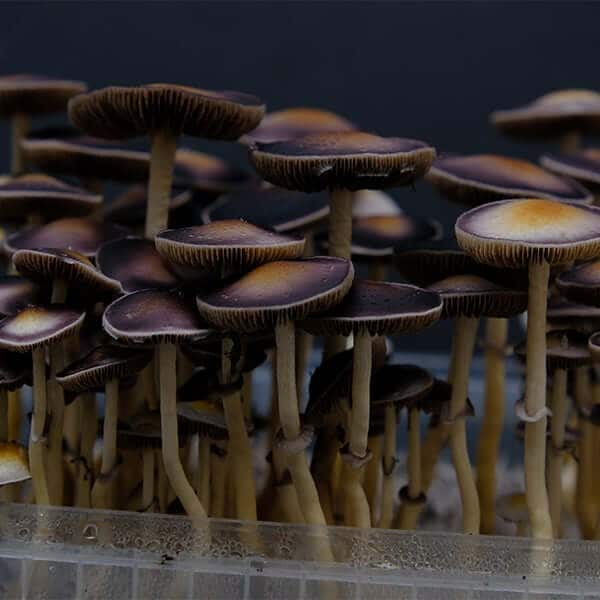
Psilocybe ochraceocentrata is a cryptic African Psilocybe described by Bradshaw, Sharp, Dentinger, and van der Merwe in Proceedings of the Royal Society B (2026). The holotype is BUL 8013 (field code CS-3006), deposited at the Natural History Museum of Zimbabwe. The epithet points to the ochre center of the pileus; Cathy Sharp holds the naming right for that character.
Published ecology places the species with grasslands and large herbivore dung in southern Africa. That is a taxonomic habitat note from the paper, not a field or lab protocol.
Molecular work recovered African specimens once labeled P. cubensis, P. cf. cubensis, or P. cf. natalensis as a monophyletic group sister to true P. cubensis. The estimated split is about 1.5 million years ago (95% HPD roughly 710,000 to 2.55 million years). That timeline challenges Guzmán's 1983 colonial cattle-introduction story as the sole origin narrative for cubensis. Keep the point as research history only.
On the slide, the species sits next to Psilocybe cubensis for size comparison and next to other species profiles such as P. ovoideocystidiata for the same measurement discipline.
Classification & Holotype
Binomial: Psilocybe ochraceocentrata C. Sharp, A. Bradshaw, B. Dentinger & B. van der Merwe (2026). Holotype: BUL 8013 (CS-3006), Natural History Museum of Zimbabwe. Etymology: Ochre center of the pileus (Cathy Sharp naming right). Closest relative (paper): Psilocybe cubensis; divergence ~1.5 Ma (95% HPD ~710k–2.55M).
Spore, Basidia & Cystidia Data
Spore print (holotype concept): Dark vinaceous-grey. Spore colour in 3% KOH: Brown to slightly reddish-brown. Basidia: 22–38 × 8–12.5 µm, mostly 4-spored. Pleurocystidia: Absent. Cheilocystidia: Not observed in holotype; clear in BUL 8014, 8015, PREM 63440–42: capitate, thin-walled, 21–26 × 9–13 µm. Label caution: Commercial "natalensis" / NSS sequences mostly cluster here, not with true natalensis type.
Nomenclature
Why Labels Said Natalensis
Vendor and community labels often used "natalensis," "Natal," or "Natal Super Strength (NSS)" for African-leaning spore lots. Bradshaw et al. checked publicly deposited sequences tied to those labels. Most clustered with P. ochraceocentrata, not with the holotype of Psilocybe natalensis Gartz, D. A. Reid, M. T. Sm. & Eicker.
True P. natalensis type sequences place sister to P. chuxiongensis and P. maluti, outside the cubensis–ochraceocentrata pair. Treat a commercial natalensis string as a label claim: record it, then compare microns and cystidia characters to the tables below before you write a binomial on the voucher.
Microscopy
Spore Morphology on the Slide
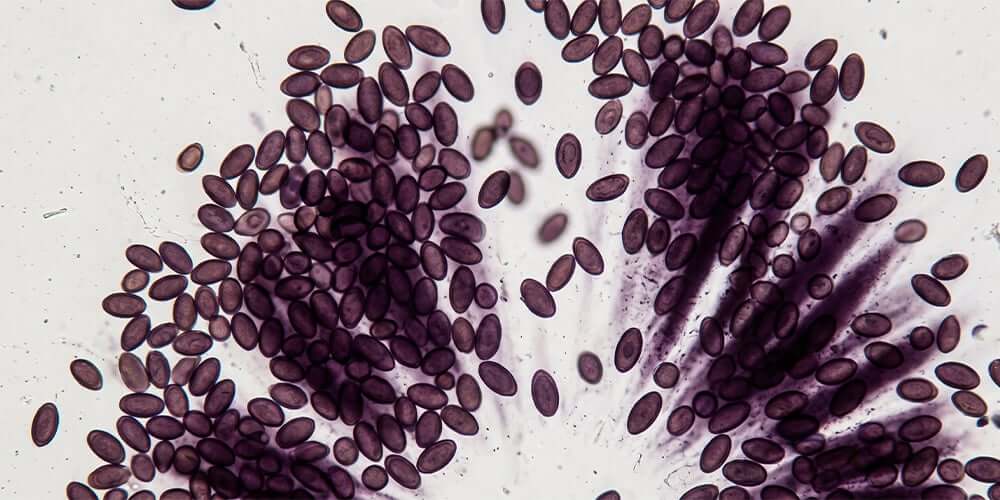
Bradshaw et al. measured n=30 side-view spores from the holotype. Spores are ellipsoid, a few lenticular; thick-walled, smooth, with a germ pore; (10–)11–11.8–12.5(–12.5) × 6.5–7.6–8 µm; Q = 1.44–1.55–1.71. Underlined means in the protologue style sit at 11.8 × 7.6 µm with Q 1.55. Spore colour in 3% KOH is brown to slightly reddish-brown. The spore print is dark vinaceous-grey.
Basidia are elongate or clavate, 22–38 × 8–12.5 µm, mostly 4-spored. Pleurocystidia are absent. Cheilocystidia were not seen in the holotype but are clear in other collections: capitate, thin-walled, 21–26 × 9–13 µm. Capitate cheilocystidia contrast with the subtly lageniform cheilocystidia of P. cubensis in the Bradshaw account.
Find a clean field at 400×, then measure at 1000× oil immersion on a calibrated ocular micrometer. Prefer side-view spores to match Bradshaw's protocol. Report range, mean, Q, and n. Method notes: How to Measure Spores Accurately. Character vocabulary: Spore Morphology Explained.
Compiled fact: a 30-spore side-view mean near Bradshaw's holotype cluster (~11.8 × 7.6 µm, Q ~1.55) sits below Guzmán's typical cubensis length cluster (13–15 µm). True natalensis type spores are described longer and wider on average ((12–)14 × (8.5–)9.5 µm concept). Spore size alone is incomplete without cystidia notes and the Bradshaw type-sequence caution: commercial "natalensis" labels often map genetically to ochraceocentrata. (Compiled from published ranges, not a new lab series.)
Comparative Data
Ochraceocentrata vs. Natalensis vs. Cubensis
This table compiles published ranges for slide work. It is not a new measurement series from Magic Spore Labs.
| Character | P. ochraceocentrata | True P. natalensis (type concept) | P. cubensis |
|---|---|---|---|
| Spore size (µm) | (10–)11–11.8–12.5(–12.5) × 6.5–7.6–8; Q 1.44–1.55–1.71 (n=30 side view, holotype) | (10.0–)12.0–14.0 × (7.0–)8.5–9.5; broadly elliptic to ovoid | (12–)13–15(–17) × 8–10(–11) × 7–9 |
| Wall / pore | Thick-walled, smooth, germ pore | Thick-walled, truncate germ pore | Thick-walled, truncate germ pore (Guzmán) |
| Print colour | Dark vinaceous-grey | Deep violet or purple | Dark purple-brown to blackish (MSL cubensis profile) |
| KOH spore colour | Brown to slightly reddish-brown (3% KOH) | Not restated here; use original sources | As in Guzmán accounts |
| Basidia | 22–38 × 8–12.5 µm, mostly 4-spored | See Reid / Gartz accounts | Typical 4-spored cubensis pattern |
| Pleurocystidia | Absent | Present (18–40 × 10–15 µm) in type concept | Present; not the ochraceocentrata "absent" state |
| Cheilocystidia | Capitate, 21–26 × 9–13 µm (other collections; not in holotype) | Lageniform, 16–22 µm | Subtly lageniform (contrast noted by Bradshaw et al.) |
| Sequence note | Sister to cubensis; commercial natalensis/NSS often here | Holotype sister to P. chuxiongensis and P. maluti | Domesticated clade; African "cubensis" records reinterpreted |
| Sources | Bradshaw et al. 2026 | Reid & Eicker / Bothalia; Gartz et al. 1995 | Guzmán 1983; Guzmán et al. 2012 |
If a natalensis-labeled slide lands near 11–12 × 7–8 µm with Q near 1.55, it matches the ochraceocentrata holotype cluster better than the longer natalensis type concept. If pleurocystidia are present and cheilocystidia are lageniform at 16–22 µm, do not force an ochraceocentrata name from vendor text alone. Cystidia need hymenium tissue.
Protocol
How to Document a Natalensis-Labeled Slide
- Record sample ID, vendor label string (including "natalensis," NSS, or other aliases), date, mount medium (note 3% KOH if you match Bradshaw spore colour notes), and magnification.
- Photograph side-view and face-view fields at 1000× oil immersion.
- Measure at least 30 side-view spores when you want to sit next to the holotype protocol. Report min–mean–max length and width, Q, and n.
- Score wall thickness, germ-pore presence, and print colour if you have a print voucher.
- If gill tissue is available, hunt for pleurocystidia (absent in ochraceocentrata; present in the natalensis type concept) and cheilocystidia shape (capitate vs lageniform).
- Compare numbers to the table above. Note the Bradshaw sequence caution on the card: commercial natalensis labels often map to ochraceocentrata.
- Do not upgrade a vendor alias to a binomial without measurements that fit a published concept.
KOH mounts and Congo red on dried lamellae appear in the Bradshaw methods as microscopy reagents. They are documentation tools, not production steps.
Scope
What This Page Will Not Do
It will not cover growing, fruiting, harvesting, inoculating, substrate, monotubs, grain spawn, agar work, potency, effects, or yields. Those topics are out of scope. Published ecology (grasslands, herbivore dung) stays in the taxonomy frame only. Divergence dating and the Guzmán cattle-introduction debate are research history, not instructions.
ComplianceLegal Status for Spore Research
Psilocybin and psilocin are Schedule I under 21 U.S.C. § 812. Spores are not named in that list. A 2 January 2024 DEA letter from Terrence L. Boos states that material is not controlled under the CSA if it does not contain psilocybin or psilocin, and that it becomes controlled if those compounds appear (for example, upon germination). Four states restrict these spores: California, Georgia, Idaho, and Florida. Magic Spore Labs does not ship to those states. Full notes: Are Mushroom Spores Legal? A State-by-State Guide. This is not legal advice.
Method
Building a Comparison Set
Keep a cubensis reference slide beside any natalensis-labeled unknown. Measure both with the same micrometer and mount habit. Research spore lots sold under the natalensis name are common; treat that string as a label that often maps to ochraceocentrata per Bradshaw et al., then confirm with microns and cystidia notes. Starting SKU for that label cluster: Psilocybe natalensis Super Strain spore syringe (research spores; label caveat applies). More options: magic mushroom spores collection.
Psilocybe natalensis Super Strain Spore Syringe
Research spores; label caveat applies. Commercial "natalensis" sequences most often cluster with P. ochraceocentrata rather than the true natalensis type, so confirm morphology and cystidia notes before assigning a binomial to this lot.
Sources
- Bradshaw, A.J., Sharp, C., Van Der Merwe, B., Tremble, K., and Dentinger, B.T.M. (2026). Discovery of the closest free-living relative of the domesticated 'magic mushroom' Psilocybe cubensis in Africa. Proc. R. Soc. B 293:20252270. doi:10.1098/rspb.2025.2270
- Reid, D.A. and Eicker, A. South African fungi 9: Psilocybe natalensis. Bothalia. doi:10.5962/p.415161 (type-concept context for true natalensis).
- Gartz, J., Reid, D.A., Smith, M.T., and Eicker, A. (1995). Psilocybe natalensis sp. nov. Integration 6:29–32.
- Guzmán, G. (1983). The Genus Psilocybe. Beihefte zur Nova Hedwigia 74. Cubensis origin discussion and spore baseline later restated in Guzmán et al. 2012.
- Guzmán, G., et al. (2012). Psilocybe s.s. in Thailand: four new species and a review of previously recorded species. Restates Guzmán 1983 cubensis spores (12–)13–15(–17) × 8–10(–11) × 7–9 µm.
- Boos, T.L., DEA Drug and Chemical Evaluation Section. Letter of 2 January 2024 on the control status of mushroom spores under the CSA. (Letter)
- Magic Spore Labs. Are Mushroom Spores Legal? A State-by-State Guide.
- Magic Spore Labs. What Is Psilocybe Cubensis. (Cubensis overview)
- Magic Spore Labs. Spore Morphology Explained.
Kyle Wilson writes microscopy and taxonomy notes for Magic Spore Labs. This profile stays on published characters: Bradshaw holotype microns, natalensis type-concept contrasts, cystidia notes, and the commercial label caution.
All spores offered by Magic Spore Labs are intended for microscopy, taxonomy, and research purposes only. Spores are not intended for cultivation. It is the customer's responsibility to know and comply with all local, state, and federal laws regarding possession and use of spore products. Magic Spore Labs does not ship to California, Georgia, Idaho, or Florida.
This profile keeps Psilocybe ochraceocentrata data anchored to Bradshaw et al.'s published measurements and vouchers, not vendor labels.
FAQs
Is Psilocybe ochraceocentrata the same as natalensis?
No. P. ochraceocentrata is a 2026 species sister to P. cubensis. True P. natalensis is a separate South African type concept whose holotype sequences sit outside the cubensis clade. Commercial "natalensis" labels often map genetically to ochraceocentrata.
What spore size should I expect on an ochraceocentrata holotype match?
Bradshaw's holotype side-view range is (10–)11–11.8–12.5(–12.5) × 6.5–7.6–8 µm (n=30), Q = 1.44–1.55–1.71. A mean near 11.8 × 7.6 µm (Q ~1.55) is the published cluster to cite.
How do ochraceocentrata spores compare with cubensis on a slide?
Compiled from published ranges: the ochraceocentrata length mean sits below Guzmán's typical cubensis length cluster (13–15 µm). Use the same calibration and side-view habit before you call the gap.
Can I finish the ID from a spore syringe alone?
You can compare spore size, shape, wall, and germ pore to published ranges. Pleurocystidia and cheilocystidia need hymenium tissue. Without that tissue, report spore metrics and keep the vendor label as a label.
Why did Bradshaw rename African material?
Multi-locus phylogeny and museomics showed African specimens long treated as cubensis-like formed a cryptic species sister to cubensis, with an estimated ~1.5 Ma split. The new name anchors that clade to holotype BUL 8013.
Are these spores legal for microscopy?
In most U.S. states, ungerminated spores are legal to possess for microscopy. They are restricted in California, Georgia, Idaho, and Florida. Magic Spore Labs does not ship to those four states.
What does the epithet ochraceocentrata mean?
It refers to the ochre center of the pileus. Cathy Sharp's naming right for that character is stated in the 2026 paper.