
Table of Contents
- What Is Jedi Mind Fuck, and Where Does It Fit in Fungal Taxonomy?
- What Do JMF Spores Look Like Under the Microscope?
- What Is the Origin and Community History of the JMF Strain?
- How Does JMF Compare to Other Psilocybe cubensis Strains for Microscopy?
- Why Did JMF Become the Subject of an FDA-Cleared Clinical Trial?
- What Are the Legal Considerations for Researchers Holding JMF Spores?
- FAQs
Quick Answer
Jedi Mind Fuck (JMF) is a community-named strain of Psilocybe cubensis (Earle) Sacc., classified within the family Hymenogastraceae. Its spores are purple-brown, ellipsoidal, and average approximately 7 × 12 μm, making them a well-defined and visually distinctive subject for microscopy and fungal taxonomy research.
Key Takeaways
- JMF is a strain of Psilocybe cubensis — it carries no independent species designation in formal mycological taxonomy
- Spores are purple-brown, averaging ~7 × 12 μm, with a clearly visible germ pore and ellipsoidal morphology under magnification
- The strain is attributed to citizen scientist “Myco Joe,” documented around 2009 in Florida
- A leucistic variant exists and circulates widely in spore research collections
- JMF was selected as the subject of the first FDA-cleared U.S. clinical trial on whole psilocybin mushrooms, conducted by the Scottsdale Research Institute under Dr. Sue Sisley
- Possession laws vary by state — California, Georgia, Idaho, and Florida restrict or prohibit possession entirely
What Is Jedi Mind Fuck, and Where Does It Fit in Fungal Taxonomy?
The name “Jedi Mind Fuck” is entirely informal — the kind of label that spreads through hobbyist spore trading networks and sticks. Taxonomically, JMF sits beneath the species level as a community-recognized strain of Psilocybe cubensis (Earle) Sacc., the most widely studied psilocybin-producing species in mycological literature.
Its full classification:
| Taxonomic Rank | Classification |
|---|---|
| Kingdom | Fungi |
| Division | Basidiomycota |
| Class | Agaricomycetes |
| Order | Agaricales |
| Family | Hymenogastraceae |
| Genus | Psilocybe |
| Species | Psilocybe cubensis (Earle) Sacc. |
| Strain | Jedi Mind Fuck (informal community designation) |
That “informal” label matters for researchers. JMF is not a separate species, subspecies, or variety in the formal mycological sense. It is a lineage — a population of P. cubensis with observable phenotypic traits that collectors and microscopists have preserved, documented, and distributed. Many cubensis strains exist in this category alongside JMF: Golden Teacher, Penis Envy, B+, Melmac, and others. None hold independent species status.
For microscopy purposes, this means JMF mushroom spores share the foundational morphological characteristics of P. cubensis while offering a set of specific, repeatable visual markers that make it a useful reference specimen for comparative taxonomy work.
Jedi Mind Fock Mushroom Spore Syringe
$24.99
Jedi Mind Fock Liquid Spores Developed by community breeder Mycotek and widely regarded as one of the more morphologically consistent Psilocybe cubensis strains available for microscopy study, Jedi Mind Fock Liquid Spores has earned a well-deserved place at the top… read more

What Do JMF Spores Look Like Under the Microscope?
This is where JMF earns its reputation among microscopists. The spores are purple-brown in color, ellipsoidal in shape, and average approximately 7 × 12 μm — consistent with published P. cubensis spore data, though field reports place the upper length range at 11–17 μm depending on collection method and slide preparation.
Under magnification, each spore displays:
- A clearly visible germ pore — the germination aperture at the spore apex, a standard feature of P. cubensis and a key identification marker in basidiospore taxonomy
- Smooth spore walls — the outer surface is not ornamented, distinguishing P. cubensis spores from species like Psilocybe semilanceata, which can appear more variable under similar preparation
- Purple-brown pigmentation — deeper in tone compared to lighter cubensis strains, making JMF spore prints visually distinctive even before slide preparation
- Ellipsoidal geometry — the characteristic oval form of P. cubensis basidiospores, neither perfectly round nor needle-shaped
The basidia — the spore-bearing cells — are four-spored, which is standard for P. cubensis and consistent with the broader Hymenogastraceae family. Under confocal or electron microscopy, additional cellular structures become visible: pleurocystidia and cheilocystidia lining the gill edges, which provide additional taxonomic reference points when comparing Psilocybe species side by side.
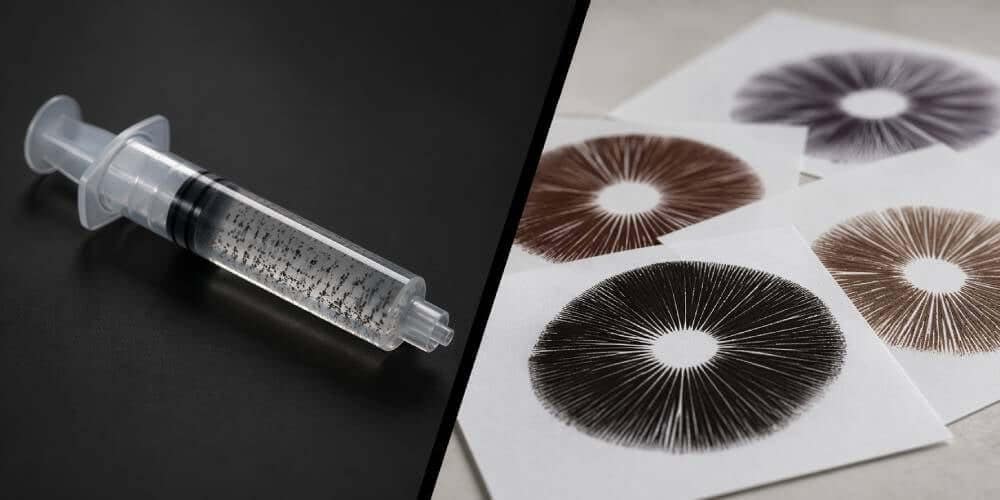
Spore prints from JMF specimens are characteristically dark purple-brown to near-black, depositing densely on collection surfaces. Some researchers note that JMF produces a moderate rather than heavy spore load compared to other high-yield cubensis strains — an observation attributed to the strain’s morphology and documented early veil separation, where the partial veil breaks before full spore maturity in some specimens.
What Is the Origin and Community History of the JMF Strain?
Like most community-named cubensis strains, JMF’s origin story exists in a gray zone between documented field discovery and community mythology. The most consistently cited account attributes the strain to a citizen scientist known in mycology circles as “Myco Joe” (also referenced as “Agar Joe”), who reportedly isolated and documented the lineage around 2009 in Florida — specifically the Mid-East Florida region, per field notes preserved in vendor records.
Competing accounts place the original discovery in Georgia in the early 2000s. Some researchers suggest JMF shares genetic lineage with the Z-strain, another community-named cubensis variety, though this remains speculative without formal genetic sequencing data to confirm it.
What is verifiable is that by the early 2010s, JMF had circulated widely through online spore trading communities and established vendor networks. The strain’s name contributed to its spread — memorable, easy to search, and carrying cultural resonance that more clinically named strains lacked. The morphological consistency of JMF across distributed collections suggests a stabilized, well-preserved lineage regardless of which origin account is accurate.
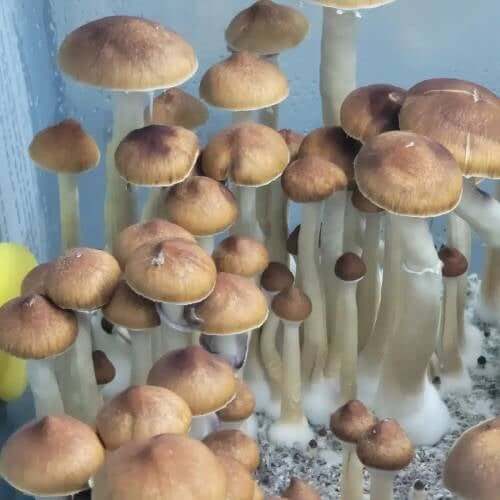
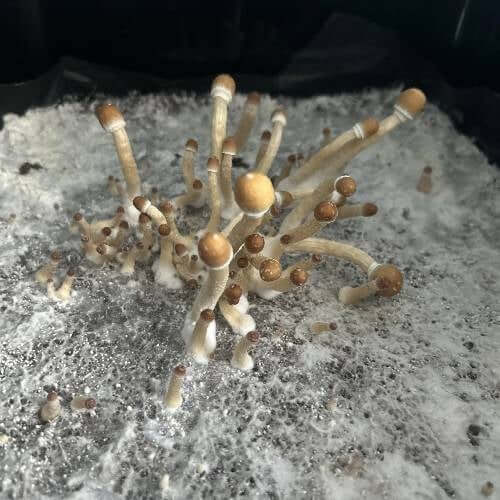
A leucistic variant of JMF also circulates in research collections. Leucistic specimens display reduced pigmentation in cap tissue while retaining normal spore morphology. For microscopists, leucistic JMF provides a useful phenotypic comparison within the same collection, illustrating how macroscopic pigmentation variation does not necessarily correspond to changes in spore structure at the microscopic level — a point of genuine interest for researchers studying P. cubensis phenotypic diversity.
How Does JMF Compare to Other Psilocybe cubensis Strains for Microscopy?
Experienced microscopists evaluate spore syringes based on visual distinctiveness under magnification, consistency of identifying features across slide preparations, and spore concentration. JMF sits in a useful middle ground: its germ pore is reliably visible, its dark pigmentation makes it easy to distinguish spore deposits from background material, and its dimensions fall cleanly within the established P. cubensis range.
| Strain | Spore Color | Approx. Size (μm) | Notable Feature | Spore Yield |
|---|---|---|---|---|
| Jedi Mind Fuck (JMF) | Dark purple-brown | ~7 × 12 | Prominent germ pore; early veil break | Moderate |
| Golden Teacher | Purple-brown | 11.5–17 × 8–11 | Classic cubensis reference morphology | High |
| Penis Envy | Purple-brown | 11–17 × 7–9 | Dense spore walls; reduced germ pore visibility | Low to moderate |
| B+ | Purple-brown | 11–15 × 7–10 | Large spore size; accessible for beginners | High |
| Melmac | Purple-brown | ~11–16 × 8–11 | Thick-walled spores; distinct cap morphology | Moderate |
Magic Spore Labs carries JMF spore syringes and spore prints prepared under sterile conditions for microscopy research. Each syringe is produced in a HEPA-filtered environment and suspended in sterile aqueous solution for reliable slide preparation.
Why Did JMF Become the Subject of an FDA-Cleared Clinical Trial?
This is the aspect of JMF’s story that separates it from nearly every other community-named cubensis strain — and it’s directly relevant to the scientific research context surrounding this species.
In March 2025, the U.S. Food and Drug Administration cleared a clinical hold on a trial being conducted by the Scottsdale Research Institute (SRI) in Arizona. The trial is led by Dr. Sue Sisley, SRI’s President and principal investigator, and is funded in part by $5 million allocated by the Arizona Legislature in 2023 for psilocybin mushroom research, dispersed through the Arizona Department of Health Services’ Psilocybin Research Advisory Council.
The trial’s significance comes from its design: it is the first clinical trial in the United States — and potentially the first in the world — to study whole psilocybin mushrooms rather than isolated psilocybin compounds on human subjects. Prior FDA-approved psilocybin research used synthesized or highly purified psilocybin molecules. SRI’s trial uses standardized whole mushroom preparations, raising open scientific questions about the role of the full alkaloid matrix alongside psilocybin.
The target population is 24 police officers, military veterans, and firefighters being treated for PTSD, chronic pain, or opioid addiction. Each participant receives approximately 4.5 grams of whole mushrooms, standardized to deliver 30 milligrams of psilocybin. SRI obtained the first DEA manufacturing license for psilocybin mushrooms four years prior to FDA clearance and completed 14 grow cycles and 40 standardization tests before finalizing the strain selection.
The chosen strain was Jedi Mind Fuck. When Dr. Sisley was asked to name it at a council meeting, the room broke into laughter. She later explained at a Multidisciplinary Association for Psychedelic Studies conference that she chose the strain partly because she enjoyed being able to write the name on government forms — though the selection was backed by extensive testing confirming the strain’s stability and consistency.
For mycology researchers and spore collectors, the selection of JMF for this landmark trial adds a layer of documented scientific attention to a strain that previously existed entirely within informal hobbyist taxonomy. It also highlights the broader research interest in P. cubensis strain diversity and observable phenotypic differences that may carry biological significance beyond spore morphology alone.
What Are the Legal Considerations for Researchers Holding JMF Spores?
Psilocybe cubensis spores do not contain psilocybin or psilocin — the alkaloids that place mature mushrooms on Schedule I of the U.S. Controlled Substances Act. This distinction creates a legal space for microscopy and taxonomy research involving spores in most U.S. states. That space, however, is not uniform.
| State | Spore Possession Status | Notes |
|---|---|---|
| California | Restricted | Possession prohibited under state law |
| Georgia | Prohibited | No sales or shipment to Georgia |
| Idaho | Prohibited | No sales or shipment to Idaho |
| Florida | Restricted | Possession restrictions apply |
| All other U.S. states | Legal for microscopy & research | Spores do not contain scheduled compounds; cultivation remains prohibited |
At the federal level, the DEA’s longstanding position is that spores themselves are not controlled substances, as they do not contain psilocybin or psilocin. The moment spores are used to produce mycelium or fruiting bodies, that distinction collapses entirely under federal law. All spore products at Magic Spore Labs are sold exclusively for microscopy and taxonomical research. Customers are responsible for verifying applicable laws in their jurisdiction before purchasing or possessing spore products.
Ready to add JMF to your microscopy collection?
Magic Spore Labs JMF spore syringes are prepared under sterile conditions and intended exclusively for microscopy and taxonomy research.
Shop JMF Spore SyringesDisclaimer: All spores offered by Magic Spore Labs are intended for microscopy, taxonomy, and research purposes only. Spores are not intended for cultivation. It is the customer’s responsibility to know and comply with all local, state, and federal laws regarding possession and use of spore products.
FAQs
What is the scientific name for Jedi Mind Fuck mushrooms?
JMF is a strain of Psilocybe cubensis (Earle) Sacc., classified within the family Hymenogastraceae. It has no independent species designation — it is an informal community lineage within P. cubensis.
What do Jedi Mind Fuck spores look like under a microscope?
JMF spores are ellipsoidal, purple-brown in color, and average approximately 7 × 12 μm. Under magnification, a clearly defined germ pore is visible at the spore apex — a standard feature of P. cubensis basidiospores and a key identification marker in taxonomy work.
Who discovered the Jedi Mind Fuck strain?
The strain is attributed to a citizen scientist known as “Myco Joe,” who documented it around 2009 in Florida. The exact origin is debated in collector communities, with some accounts placing the discovery in Georgia in the early 2000s.
Why was JMF chosen for the Scottsdale Research Institute clinical trial?
Dr. Sue Sisley of the Scottsdale Research Institute selected JMF for the first FDA-cleared U.S. clinical trial on whole psilocybin mushrooms. The strain was chosen after 14 grow cycles and 40 standardization tests confirming its consistency. Dr. Sisley has also noted she appreciated being able to write the name on government forms.
Are Jedi Mind Fock spores legal to possess?
In most U.S. states, P. cubensis spores are legal to possess for microscopy and research purposes because they do not contain psilocybin or psilocin. Possession is restricted or prohibited in California, Georgia, Idaho, and Florida. Customers are responsible for verifying applicable laws in their jurisdiction.
What is a leucistic JMF variant?
Leucistic JMF is a phenotypic variant displaying reduced pigmentation in cap tissue. Spore morphology remains consistent with standard JMF, making it a useful comparison specimen for microscopists studying pigmentation variation within P. cubensis.
How should JMF spore syringes be stored for research use?
Store JMF spore syringes refrigerated at 2–8°C in a sealed, dark environment. Under optimal conditions, spore viability is maintained for 6–12 months. Spore prints sealed in foil packets can remain viable longer when kept cool and dry, away from direct light and humidity.