
Table of Contents
- What Is Golden Teacher, and How Is It Classified in Fungal Taxonomy?
- What Are the Spore Characteristics of Golden Teacher Under the Microscope?
- Why Is Golden Teacher the Reference Standard for P. cubensis Microscopy?
- What Is the Origin and History of the Golden Teacher Strain?
- How Do Golden Teacher Spores Compare to Other P. cubensis Strains?
- What Are the Legal Considerations for Researchers Holding Golden Teacher Spores?
- FAQs
Quick Answer
Golden Teacher Spores is a community-named strain of Psilocybe cubensis (Earle) Sacc., family Hymenogastraceae. Its spores are subellipsoid, dark purple-brown in deposit, and measure 11–17 × 7–12 μm — among the most consistent and clearly defined of any P. cubensis strain, making it the reference standard for cubensis microscopy worldwide.
Key Takeaways
- Golden Teacher is a morphological variant of Psilocybe cubensis — it has no independent species designation in formal mycological taxonomy
- Spores measure 11–17 × 7–12 μm, subellipsoid, dark purple-brown in deposit, with smooth walls and a clearly visible apical germ pore
- The strain first appeared in hobbyist literature around 1988–1989; precise geographic origin remains debated between subtropical regions of the southern U.S. and Southeast Asia
- A leucistic variant exists, featuring reduced cap pigmentation while retaining standard spore morphology
- Golden Teacher is the benchmark reference strain for P. cubensis microscopy due to prolific sporulation, consistent spore dimensions, and textbook-visible diagnostic features
- P. cubensis spores do not contain psilocybin or psilocin; possession for microscopy research is legal in most U.S. states, with exceptions in California, Georgia, Idaho, and Florida
What Is Golden Teacher, and How Is It Classified in Fungal Taxonomy?
Golden Teacher is one of the most recognized names in the Psilocybe cubensis community — not because of any formal taxonomic distinction, but because of what it represents in practice: a reliable, prolific, and well-documented strain that has served as the default entry point for cubensis microscopy research for decades.
In formal taxonomy, there is no species named Psilocybe golden teacher. The strain sits beneath the species level as an informal cultivar designation within Psilocybe cubensis (Earle) Sacc. — a species first described in Cuba in 1906 by American mycologist Franklin Sumner Earle, who originally classified it as Stropharia cubensis. Italian mycologist Pier Andrea Saccardo later revised the name to Psilocybe cubensis. Gastón Guzmán’s landmark 1983 monograph The Genus Psilocybe remains the foundational taxonomic treatment researchers reference today.
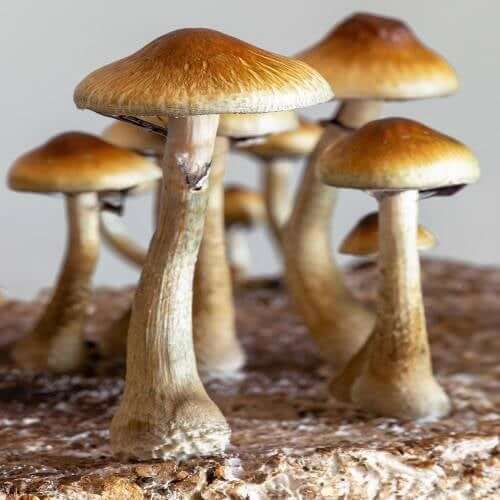
The name “Golden Teacher” has two components: “Golden” refers to the characteristic golden-yellow to caramel coloration of mature pileus (cap) tissue, and “Teacher” is an informal designation reflecting the strain’s longstanding reputation as an accessible introduction to cubensis morphology and microscopy. Neither component carries formal taxonomic weight, but the name has been stable in hobbyist and vendor literature for nearly four decades.
| Taxonomic Rank | Classification |
|---|---|
| Kingdom | Fungi |
| Division | Basidiomycota |
| Class | Agaricomycetes |
| Order | Agaricales |
| Family | Hymenogastraceae |
| Genus | Psilocybe |
| Species | Psilocybe cubensis (Earle) Sacc. |
| Strain | Golden Teacher (informal community designation) |
What Are the Spore Characteristics of Golden Teacher Under the Microscope?
Golden Teacher spores holds its status as the reference strain for a concrete reason: its spore morphology is exceptionally consistent and well-suited for observation. Where other cubensis strains may show variation across preparations, Golden Teacher spores reliably display the diagnostic features of P. cubensis in clean, clearly resolved form.
- Spore dimensions: 11–17 × 7–12 μm (subellipsoid). Singer and Smith’s classic species description places P. cubensis spore width at 8.8–10.5 μm; Golden Teacher sits comfortably within this range. For reliable measurement, examine a minimum of 20 spores per slide to establish a dependable average.
- Shape: Subellipsoid — a classic oval form, slightly wider at the center and tapering gently toward both poles. This geometry is one of the defining features distinguishing Psilocybe basidiospores from other genera.
- Color: Dark purple-brown in bulk deposit (spore prints). Under transmitted light on a prepared slide, individual spores appear more amber to yellow-brown, particularly in KOH mounting solution — a reaction that assists species confirmation.
- Germ pore: A single, clearly visible apical germ pore is present at the truncated end of each spore. Reliably resolved at 400× magnification; 1000× oil immersion recommended for detailed wall structure examination.
- Spore wall: Smooth, moderately thick-walled. The absence of surface ornamentation distinguishes P. cubensis from genera with roughened or sculptured spore surfaces.
- Basidia: Four-spored, consistent with P. cubensis and the broader Hymenogastraceae family. On well-prepared samples, the four sterigmata may be observed under higher magnification.
- Cystidia: Pleurocystidia (on gill faces) and cheilocystidia (on gill edges) are present and provide additional taxonomic reference points when examining tissue sections alongside spore samples.
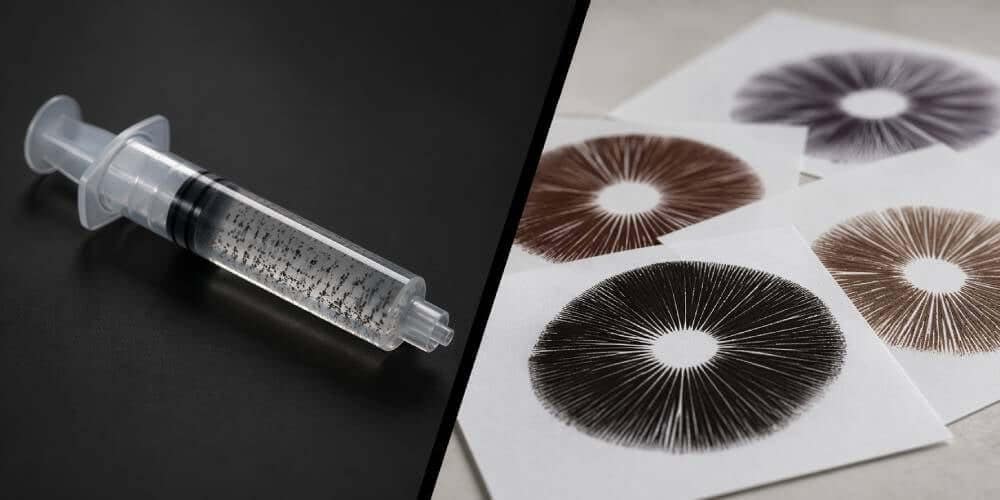
- Spore print color: Dark purplish-brown to near-black. Golden Teacher is a prolific spore producer — a single mature specimen can deposit millions of spores onto a collection surface, making it one of the most efficient strains for slide preparation and repeat study.
This high spore yield, combined with consistent morphology, is the primary reason Golden Teacher mushroom spores is routinely recommended as the first specimen for researchers new to cubensis microscopy.
Golden Teacher Mushroom Spore Syringe
$24.99
Golden Teacher Liquid Spores Widely regarded as one of the most popular strains for microscopy research and a top choice among mycology enthusiasts for its distinctive morphology, the Golden Teacher Mushroom Spores strain is a longstanding favorite. It is among… read more

Why Is Golden Teacher the Reference Standard for P. cubensis Microscopy?
The term “reference strain” has a specific meaning in the context of cubensis microscopy: Golden Teacher is the strain researchers use to calibrate technique, validate equipment settings, and establish a morphological baseline against which all other strains are compared. Three concrete reasons explain why:
Spore consistency
Lower variability in spore dimensions across preparations than most cubensis strains. Where strains like Penis Envy can show irregular size distribution or reduced germ pore visibility, Golden Teacher spores resolve cleanly at standard magnification with predictable results.
Prolific sporulation
Spore density on prints and in suspension is high compared to many cubensis strains, giving researchers abundant material for multiple slides, repeated observations, and comparative work without exhausting a single sample.
Documented lineage
In documented circulation longer than most named cubensis strains. That depth of community and vendor documentation means researchers can cross-reference observations against a large existing body of notes, images, and comparative data.
A 2025 peer-reviewed study published via PMC/NIH examining P. cubensis strain diversity confirms Golden Teacher’s standing as one of the most prominent reference strains, with Singer and Smith’s morphological baseline aligning closely with observed measurements. The study also highlights how legislative restrictions on psilocybin have historically limited formal academic research on Psilocybe species — meaning much of the foundational strain documentation remains community-sourced rather than peer-reviewed.
What Is the Origin and History of the Golden Teacher Strain?
The origin of Golden Teacher occupies a gray zone between documented field discovery and community mythology — a pattern common to most named cubensis strains that emerged from informal hobbyist networks before formal academic documentation was feasible.
The name first appears in hobbyist literature approximately 1988–1989, during a period of expanding interest in P. cubensis taxonomy and spore collection. Unlike geographically named strains such as Ecuador or Mazatapec — where the name directly encodes a collection location — Golden Teacher is named for appearance and perceived character rather than provenance. This makes tracing its origin harder.
Two competing accounts exist. The more commonly cited places the original specimen in a subtropical region of the southern U.S. Gulf coast. The second points to Southeast Asia, consistent with the broad natural distribution of P. cubensis documented by Paul Stamets in Psilocybin Mushrooms of the World (1996). Neither account has been confirmed through formal genetic sequencing or type specimen documentation.
What is not in dispute is the strain’s stability. Morphological consistency across decades of distributed collections strongly suggests a well-preserved, true-breeding lineage. Whatever the original source, the Golden Teacher that circulates in research collections today displays the same reliable morphological profile it has shown for nearly four decades.
A leucistic variant of Golden Teacher also circulates widely. Leucistic specimens display reduced pigmentation in cap tissue — producing lighter, sometimes near-white pileus coloration — while retaining standard P. cubensis spore morphology, including the characteristic dark purple-brown spore print color. For microscopists, the leucistic variant provides a useful comparison specimen: it illustrates that macroscopic pigmentation variation does not correspond to changes in spore structure at the microscopic level, a point of interest for researchers studying P. cubensis phenotypic diversity.

How Do Golden Teacher Spores Compare to Other P. cubensis Strains?
Because Golden Teacher functions as the morphological baseline, comparing other strains to it is one of the primary exercises in cubensis microscopy. The table below covers the most commonly studied strains:
| Strain | Spore Size (μm) | Print Color | Germ Pore Visibility | Spore Yield | Scope Difficulty |
|---|---|---|---|---|---|
| Golden Teacher | 11–17 × 7–12 | Dark purple-brown | Excellent | High | Beginner |
| Leucistic Golden Teacher | 11–17 × 7–12 | Dark purple-brown | Excellent | High | Beginner |
| B+ | 11–15 × 7–10 | Purple-brown | Good | High | Beginner |
| Jedi Mind Fuck | ~7 × 12 | Dark purple-brown | Excellent | Moderate | Beginner–Intermediate |
| Melmac | ~11–16 × 8–11 | Purple-brown | Good | Moderate | Intermediate |
| Penis Envy | 11–17 × 7–9 | Purple-brown | Moderate | Low–Moderate | Intermediate |
Golden Teacher and its leucistic variant sit at the most accessible end of the difficulty range. Penis Envy sits at the harder end — lower spore yield and more variable germ pore resolution make it better suited to researchers who have already established their technique on a high-yield reference strain.
Magic Spore Labs carries Golden Teacher spore syringes, spore prints, and liquid spores for microscopy and taxonomy research. For a practical step-by-step guide to working with Golden Teacher liquid spores under the microscope, see our post How to Use Golden Teacher Liquid Spores.
What Are the Legal Considerations for Researchers Holding Golden Teacher Spores?
Psilocybe cubensis spores — including Golden Teacher spores — do not contain psilocybin or psilocin. This is the operative legal fact that creates the space for microscopy and taxonomy research in the United States: because the controlled substances are present only in mature mycelium and fruiting bodies, ungerminated spores sit outside Schedule I of the Controlled Substances Act at the federal level.
State law introduces exceptions that researchers must account for before purchasing or possessing spore products:
| State | Spore Possession | Notes |
|---|---|---|
| California | Restricted | Prohibited under state law |
| Georgia | Prohibited | No sales or shipment to Georgia |
| Idaho | Prohibited | No sales or shipment to Idaho |
| Florida | Restricted | Possession restrictions apply |
| All other U.S. states | Legal for microscopy & research | Spores contain no scheduled compounds; cultivation remains federally prohibited regardless of state |
All spore products at Magic Spore Labs are sold strictly for microscopy, taxonomy, and research purposes. Customers are responsible for verifying applicable laws in their jurisdiction prior to purchase.
Add Golden Teacher to your microscopy collection
Magic Spore Labs Golden Teacher spore syringes, prints, and liquid spores are prepared under sterile conditions and intended exclusively for microscopy and taxonomy research.
Shop Golden Teacher SporesDisclaimer: All spores offered by Magic Spore Labs are intended for microscopy, taxonomy, and research purposes only. Spores are not intended for cultivation. It is the customer’s responsibility to know and comply with all local, state, and federal laws regarding possession and use of spore products.
FAQs
What is the scientific name for Golden Teacher?
Golden Teacher is a strain of Psilocybe cubensis (Earle) Sacc., family Hymenogastraceae. It has no independent species designation — it is a community-recognized morphological variant within P. cubensis.
What do Golden Teacher spores look like under a microscope?
Subellipsoid, dark purple-brown in deposit, measuring 11–17 × 7–12 μm. Under transmitted light, individual spores appear amber to yellow-brown in KOH solution. A clearly visible apical germ pore is present at 400× magnification, with smooth spore walls consistent across preparations.
Why is Golden Teacher considered the reference strain for P. cubensis microscopy?
Three reasons: exceptionally consistent spore dimensions across preparations, high spore yield providing abundant material for repeat study, and longer documented circulation history than most named cubensis strains — giving researchers more published comparative data to reference.
When did Golden Teacher first appear, and where did it originate?
The name first appeared in hobbyist literature approximately 1988–1989. Geographic origin remains debated — the two most commonly cited accounts point to subtropical regions of the southern U.S. Gulf coast or Southeast Asia. No formal genetic sequencing has confirmed either account.
What is leucistic Golden Teacher?
A phenotypic variant of the Golden Teacher strain displaying reduced pigmentation in cap tissue. Spore morphology — including dimensions, germ pore visibility, and dark purple-brown spore print color — remains fully consistent with standard Golden Teacher.
How does Golden Teacher compare to Penis Envy for microscopy?
Golden Teacher is significantly more accessible: it produces far more spores per specimen, germ pore visibility is more reliable, and spore dimensions are more consistent across preparations. Penis Envy is lower-yield with more variable morphology under magnification — recommended only after technique is established on a reference strain like Golden Teacher.
Are Golden Teacher spores legal to purchase and possess?
In most U.S. states, yes — for microscopy and research purposes. Possession is restricted or prohibited in California, Georgia, Idaho, and Florida. Customers are responsible for verifying local laws before purchasing.
How should Golden Teacher spore syringes be stored?
Refrigerate at 2–8°C in a sealed, dark environment. Spore viability is maintained for 6–12 months under optimal conditions. Spore prints sealed in foil packets can remain viable longer when stored cool, dry, and away from direct light and humidity fluctuation.