
Table of Contents
If you've spent any time browsing quality mushroom spore prints, you've probably noticed that the Cambodian strain keeps coming up. There's a good reason for that -- it's one of the most forgiving, well-documented varieties out there, and microscopy enthusiasts have been reaching for it for years.
Cambodian mushroom spore prints have built up a real reputation in the research community, not because of hype but because the spores consistently deliver under the microscope. Whether you're just getting into spore study or you've been doing this for a while, this one deserves a closer look.
Cambodian mushroom spore prints come from a Psilocybe cubensis variety first documented near the Angkor Wat temple complex in Cambodia. They're widely used in microscopy for their dense, dark spore deposits, characteristic spore morphology, and consistent print quality. For researchers and hobbyists alike, they're considered a beginner-friendly yet scientifically interesting specimen.
What Are Cambodian Mushroom Spore Prints?
The Cambodian strain of Psilocybe cubensis was reportedly first collected in the early 2000s near the ancient Angkor Wat temple ruins in Siem Reap, Cambodia. The story goes that ethnobotanist and mycologist John Allen -- who spent a lot of time documenting fungal species across Southeast Asia -- was one of the early figures to document and bring this variety to wider attention.
What makes it stand out from other cubensis varieties? Mostly its combination of reliable spore production and distinctive visual characteristics under magnification. The spores themselves are subellipsoid to ellipsoid in shape, deep purple-brown in color, and typically measure around 11.5-17 x 7-12 micrometers. That size range, combined with thick cell walls and a pronounced germ pore, makes them excellent study material for anyone interested in fungal spore morphology.
What the Print Itself Looks Like
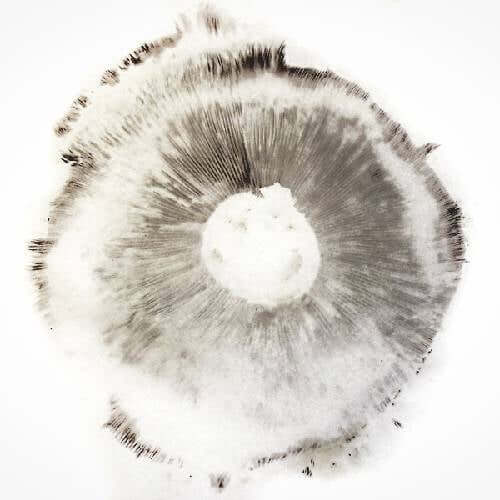
A Cambodian spore print is usually a deep brownish-purple to near-black, dense, and fairly uniform. Prints made from mature caps tend to show heavy spore deposition -- one of the reasons this variety is so popular with people who make prints for archival or educational purposes. The coverage is consistent across the print, which is something you don't always get with every strain.
At a glance -- Cambodian strain characteristics:
Why Researchers and Hobbyists Love Cambodian Spore Prints
Ask anyone who's been doing spore microscopy for a few years which strains they keep coming back to, and Cambodian almost always ends up on the list. Part of it is just practicality -- the spores are well-documented, easy to find in quality form, and they behave predictably on slides.
Great for Learning Spore Anatomy
For newcomers to mycology microscopy, Cambodian is one of the best starting points. The spore size sits in a range that's easy to work with at standard magnifications (400x-1000x), and the thick walls with visible germ pore give you a lot to observe and compare. If you're building up a reference collection or just trying to understand what you're looking at, this strain gives you clear, textbook-quality examples of what Psilocybe cubensis spores actually look like.
Shelf Life and Storage
One underrated advantage of Cambodian Mushroom Spore Prints is how well they tend to hold up in storage. Because the spore deposit is dense and the individual spores are thick-walled, properly stored prints (cool, dark, sealed) stay viable for microscopy work for a long time. Some collectors report prints staying in excellent condition for several years when stored correctly. That's not unique to Cambodian, but the density of the deposit means you're working with more material to begin with.
"Cambodian is one of those strains we always keep in stock because the demand is just consistent. Customers come back for it -- not just beginners but experienced collectors who want a reliable print for comparison work or to add to a reference set. The print quality we see from quality sources is genuinely hard to beat for the price point. If someone asks us where to start with spore prints, this is usually the first or second name out of our mouths."
Cambodian Spore Prints vs. Other Popular Southeast Asian Varieties
Southeast Asia has produced some of the most well-regarded Psilocybe cubensis strains in the research community. Cambodia isn't the only one worth knowing about. Here's how it stacks up against a few other regional varieties that come up regularly in microscopy circles:
| Strain | Region of Origin | Spore Color | Print Density | Spore Size (approx.) | Researcher Notes |
|---|---|---|---|---|---|
| Cambodian | Cambodia (Angkor Wat area) | Deep purple-brown | Very dense | 11.5-17 x 7-12 µm | Highly consistent, beginner-friendly |
| Thai | Thailand (Koh Samui area) | Dark purple-brown | Dense | 11-17 x 7-11 µm | Well-documented, similar profile |
| Vietnamese | Vietnam | Purple-brown | Moderate-dense | 11-16 x 7-10 µm | Less common, interesting comparison |
| Burmese | Myanmar | Dark brown-purple | Moderate | 11-15 x 7-10 µm | Popular for archival collections |
| Malaysian | Malaysia | Purple-brown | Moderate | 11-15 x 7-11 µm | Less widely available |
The Cambodian and Thai strains are probably the two most comparable in terms of spore characteristics and print quality. If you have both in a reference collection, the differences are subtle but interesting to observe side by side.
Spore prints and spore syringes are sold strictly for microscopy, taxonomy research, and educational purposes. Psilocybe cubensis is a controlled substance in many jurisdictions. Always check your local laws before purchasing. Magic Spore Labs spore products are not intended for cultivation and are not to be used in any way that violates federal, state, or local laws.
Cambodian Mushroom Spore Prints
$24.99
$37.48
Cambodian Spore Print The Cambodian Spore Print is a prized choice for enthusiasts and researchers who value resilience and consistency. Originating from Southeast Asia, this strain is known for its vigorous growth and ability to thrive under a variety of… read more

What to Look For When Buying Cambodian Mushroom Spore Prints
Not all spore prints are made equal. Quality varies a lot depending on how and where the print was made, how it was stored before it got to you, and whether contamination was managed properly during the process. When you're shopping for Cambodian spore prints specifically, a few things are worth paying attention to.
Print Density
A quality Cambodian print should be dark, full, and show even coverage. Thin or patchy deposits can make microscopy work harder than it needs to be.
Packaging
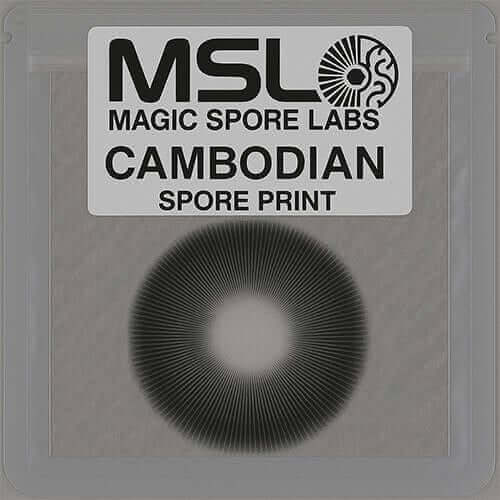
Prints should be individually sealed, ideally with a desiccant packet, and stored away from light. Any reputable vendor should be packaging them this way.
Contamination-Free
Mold or bacterial contamination on a print will ruin slides and waste your time. Buy from vendors who take sanitation seriously during the print-making process.
Clear Labeling
Your print should be clearly labeled with the strain name and ideally a lot number or date. Good record-keeping from the vendor is a sign of professionalism.
Spore Prints vs. Spore Syringes -- Which Should You Get?
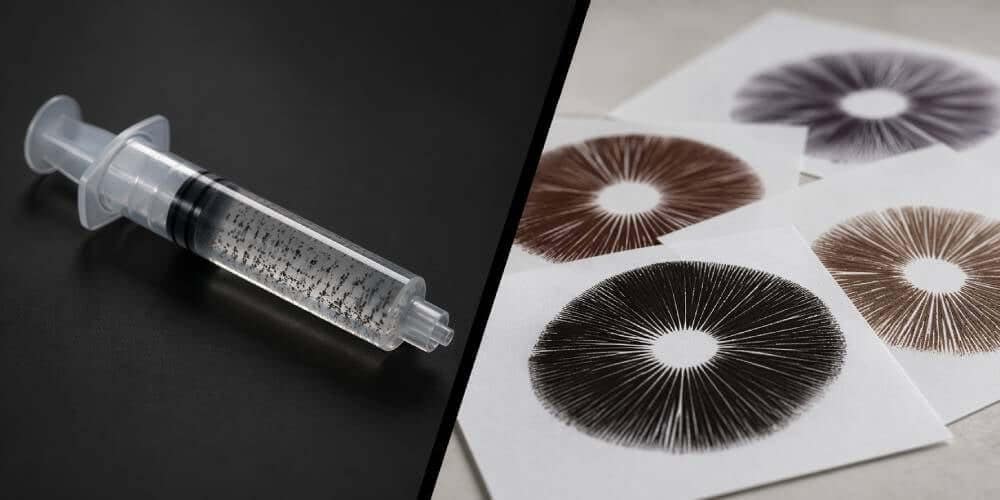
This comes up a lot, so it's worth adressing directly. Prints and syringes are both useful for microscopy but in slightly different ways. A spore print is the raw, dry deposit -- great for long-term storage and making your own syringes later. A spore syringe is the print material suspended in sterile water, which makes it a lot easier to prepare slides quickly without the intermediate steps. For beginners, syringes are often more practical. For collectors and anyone building a reference library, prints are the way to go because they store better over time.
Shop Cambodian Spore Prints at Magic Spore Labs
We carry Cambodian spore prints and syringes made from quality, contamination-screened source material. Every order is carefully packaged for safe, discreet delivery.
View Our Spore PrintsCambodian mushroom spore prints have earned their spot as one of the go-to varieties for microscopy researchers and hobbyists, and honestly, it's not hard to see why. Consistent print quality, distinctive spore morphology, and a well-documented history from a genuinely fascinating geographic origin make this Southeast Asian variety one of the best places to start -- or to keep coming back to. If you're building out your reference collection or just want a strain that'll photograph well under the scope, Cambodian Mushroom Spore Prints is a solid call every time.
FAQs
Are Cambodian mushroom spore prints legal to buy?
In most U.S. states, spore prints of Psilocybe cubensis are legal to purchase for microscopy and research purposes because the spores themselves do not contain psilocybin or psilocin -- the compounds that are federally controlled. However, California, Georgia, and Idaho have state-level restrictions on spore possession. Always verify the laws in your specific state or country before ordering, and note that cultivating these spores is illegal in most jurisdictions.
How do I store a Cambodian spore print to make it last?
For long-term storage, keep your print in a sealed, airtight bag with a small silica gel desiccant packet to control moisture. Store it in a cool, dark place -- a drawer or a small container in a cool room works fine. Refrigerator storage is an option if you're keeping them for an extended period, but make sure the print is fully sealed to prevent condensation issues. Stored properly, a dense Cambodian print can remain useable for microscopy for several years.
What magnification works best for viewing Cambodian spores under a microscope?
For basic spore observation, 400x magnification is usually sufficient to see shape, color, and general morphology clearly. For finer detail -- like the germ pore or wall thickness -- bumping up to 1000x with immersion oil gives you a much sharper look. Cambodian spores photograph particularly well at 400x for reference images because the size and contrast work well together. A basic compound microscope with a 40x and 100x objective lens is all you really need to get started.