

Table of Contents
- The Historical Roots of the Mazatec Variety
- Understanding Maz Mushroom Spore Prints
- Key Characteristics Researchers Observe in Mazatec Spore Prints
- Color and Appearance of Mazatec Spore Deposits
- Microscopy Characteristics of Mazatec Spores
- Growth Characteristics Observed in Research Settings
- Why Researchers Continue to Study This Classic Variety
- Proper Storage and Archival Techniques
- Comparing Mazatec With Other Cubensis Varieties
- The Role of Spore Print Collections in Mycology
- Responsible Research and Documentation
- Conclusion
- FAQs
Within the world of mycological research, certain classic varieties of Psilocybe cubensis continue to attract attention because of their history, identifiable traits, and consistency in laboratory observations. Among these well-known varieties, Maz Mushroom Spore Prints hold a particularly respected place. Often referred to as Mazatapec or Mazatec, this traditional strain traces its roots to the Mazatec highlands of Oaxaca, Mexico.
Researchers and microscopy enthusiasts value this variety for its recognizable phenotypic traits and distinctive spore morphology. Over decades of study, it has become one of the classic reference varieties used for observing cubensis spore structure, basidia formation, and taxonomic identification patterns under a microscope.
This overview explores the background, identifying features, microscopy value, and archival handling methods associated with Maz Mushroom Spore Prints while explaining why the variety continues to be studied by collectors and educators today.
The Historical Roots of the Mazatec Variety
The Mazatec variety is closely associated with the mountainous regions of Oaxaca in southern Mexico. The name itself derives from the indigenous Mazatec people who inhabit the region. Historical ethnographic accounts describe traditional ceremonial uses of local mushrooms in Mazatec culture, which later drew the attention of researchers and ethnobotanists during the mid-20th century.
When specimens of the local cubensis mushrooms were documented and shared among mycologists, the variety became informally known as Mazatapec. Over time, the name Mazatec became widely accepted as a more culturally accurate reference to the region and its people.
For microscopy researchers, the significance of this variety lies not only in its heritage but also in its stability as a recognizable cubensis phenotype. Because the characteristics have remained relatively consistent across samples, the variety serves as a useful educational example when comparing different cubensis strains.

Understanding Maz Mushroom Spore Prints
In mycological research, spore prints represent one of the most fundamental methods of documenting mushroom species. A spore print is created when mature mushroom caps release spores onto a sterile surface, leaving behind a dense deposit of microscopic reproductive cells.
Maz Mushroom Spore Prints are typically collected under controlled conditions onto sterile aluminum foil or specialized laboratory paper. This process preserves the spores in a stable form that can be stored for extended periods while maintaining structural integrity for microscopic examination.
These prints serve multiple research functions. They allow mycologists to analyze spore shape, confirm species identification, and preserve genetic material for long-term archival study. Because the print format is compact and stable, it has become one of the most widely used formats for microscopy collectors and research archives.
Maz Mushroom Spore Prints
$24.99
$37.48
Maz Spore Print The Maz Spore Print is a sought-after choice among researchers and collectors for its connection to the legendary Mazatec strain. Originally linked to the Mazatec people of Mexico, this strain is admired for its resilience and adaptability,… read more

Key Characteristics Researchers Observe in Mazatec Spore Prints
When examining Mazatec samples under laboratory conditions, several recognizable characteristics help researchers identify and document the variety. These traits are frequently referenced in microscopy guides and educational materials.
- Deep Purple-Brown Spore Deposits: Mature prints typically display dense coloration, which helps improve visibility during microscopic examination.
- Subellipsoid Spore Shape: Under magnification, spores often appear slightly elongated with smooth outer walls.
- Four-Spored Basidia Structure: Mazatec specimens generally develop spores on four-spored basidia, a classic cubensis feature.
- Consistent Morphology: Many researchers note that spores from this variety show reliable structural uniformity across samples.
- Strong Print Density: Mature caps frequently produce thick deposits of spores, creating well-defined prints useful for microscopy study.
- Clear Germ Pore Visibility: The germ pore is often easy to observe, making the variety useful for educational demonstrations.
Because these features are easy to observe and repeat across multiple samples, the variety is often recommended as a starting point for students learning to identify cubensis spores.
Color and Appearance of Mazatec Spore Deposits
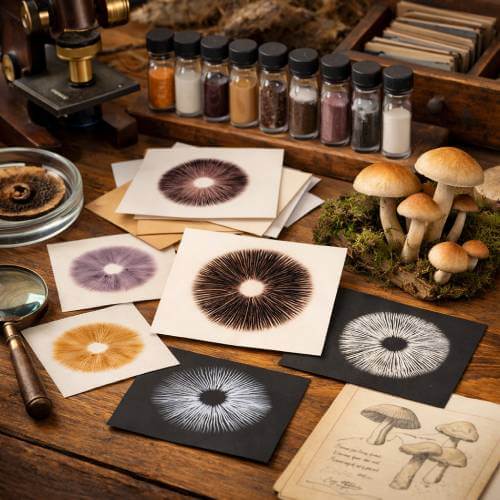
One of the defining visual characteristics of Maz Mushroom Spore Prints is the color of the spore deposit. When collected properly, the spores form a dense layer that appears deep purple-brown in color. This coloration is typical of many cubensis varieties but often appears particularly rich and dark in Mazatec prints due to the density of spores released by mature caps.
Under magnification, the spores display a smooth surface texture and a slightly elongated form typical of cubensis varieties. The intensity of the spore deposit often makes these prints visually striking, especially when preserved on aluminum foil where the metallic surface enhances contrast.
Because of this strong color contrast, Mazatec prints are often used in teaching environments when demonstrating how spore prints can help differentiate mushroom species.
Microscopy Characteristics of Mazatec Spores
Microscopic observation reveals several features that make Mazatec spores a useful subject for taxonomic study. The spores are typically described as subellipsoid in shape and develop on four-spored basidia, a structure commonly observed in cubensis mushrooms.
Under high magnification, researchers often examine the spore wall structure, the germ pore location, and overall symmetry of the spore body. These elements are important when distinguishing cubensis varieties from other closely related species within the Psilocybe genus.
Because Mazatec spores generally display consistent morphology, they serve as a reliable reference point when students or hobbyists begin learning how to identify cubensis spores through microscopy. The clarity of the spore outline and the distinct germ pore often make them easier to observe compared to more irregular strains.
Growth Characteristics Observed in Research Settings
Although research with cubensis varieties varies depending on methodology and environmental conditions, Mazatec specimens have developed a reputation for consistent growth patterns. Compared with faster-colonizing varieties such as B+ or Cambodian strains, Mazatec is commonly described as a slower but steady colonizer.
Researchers frequently note that the variety tends to develop uniform and symmetrical structures during growth phases. When observed in controlled cultivation environments used for academic study, Mazatec mushrooms often display slender stems and elegant proportions.
The caps typically appear warm golden-brown or cinnamon colored. In many cases they remain slightly convex even when fully mature, giving the mushrooms a distinctive visual appearance compared with strains that flatten completely as they develop.
These stable physical characteristics make the variety particularly interesting for documenting phenotypic consistency across generations.
Why Researchers Continue to Study This Classic Variety
In mycology, classic varieties serve an important purpose. They act as reference points that allow researchers to compare growth patterns, morphology, and spore characteristics across different strains.
Maz Mushroom Spore Prints remain valuable because the variety has been widely documented for decades. Its recognizable features and relatively stable traits allow students and collectors to develop familiarity with cubensis identification techniques.
Additionally, the cultural history associated with the Mazatec region provides historical context for discussions about mushroom ethnography and traditional knowledge. When researchers examine the origins of documented cubensis varieties, Mazatec is often one of the first examples discussed because of its strong connection to indigenous heritage.
Proper Storage and Archival Techniques
Maintaining the integrity of spore prints is essential for long-term research use. Because spores are microscopic and delicate, proper storage methods help prevent contamination, moisture exposure, and environmental damage.
Most Mazatec prints are collected onto sterile aluminum foil. The foil is then folded carefully to protect the spore deposit from light and airborne contaminants. Once sealed, the prints can be placed inside protective envelopes or laboratory containers designed for archival storage.
Temperature stability also plays an important role. Many collectors store prints in cool, dark environments to help preserve their structural quality over time. When stored correctly, spore prints can remain suitable for microscopy research for many years.
These preservation techniques allow educational institutions, collectors, and researchers to build long-term libraries of documented mushroom varieties.
Comparing Mazatec With Other Cubensis Varieties
Within the broader category of Psilocybe cubensis, numerous varieties exist, each with subtle differences in appearance and development patterns. When comparing Maz Mushroom Spore Prints to other well-known varieties, several distinctions become noticeable.
For example, B+ varieties are commonly described as fast colonizers with broad caps and rapid growth cycles. Cambodian varieties are similarly known for their vigorous colonization speed and robust structure.
Mazatec, by contrast, is frequently characterized by its patience and balance. Rather than rapid expansion, the variety tends to develop steadily and produce symmetrical structures that many researchers consider visually elegant.
These differences illustrate why studying multiple varieties can provide a broader understanding of cubensis diversity.
The Role of Spore Print Collections in Mycology
Spore print collections serve as important research archives within the mycology community. By preserving spores from documented mushroom specimens, researchers create reference materials that can be used for identification, comparison, and educational purposes.
Maz Mushroom Spore Prints are commonly included in these collections because of their historical significance and distinctive characteristics. Many microscopy enthusiasts begin building their libraries with classic varieties like Mazatec before expanding into more rare or experimental strains.
Over time, these collections become valuable records of fungal biodiversity and strain documentation.
Responsible Research and Documentation
When working with spore prints, responsible documentation practices are essential. Researchers often label prints with detailed information including the variety name, collection date, source, and storage conditions.
Accurate labeling helps ensure that samples remain traceable and that future researchers can understand the origin of the material being studied. Proper documentation also prevents confusion between closely related cubensis varieties that may appear similar under casual observation.
Because Maz Mushroom Spore Prints is a historically recognized variety, maintaining clear identification records helps preserve the lineage and context of the sample.
Conclusion
Maz Mushroom Spore Prints represent one of the most historically recognized and visually distinctive varieties within the cubensis research community. Originating from the Mazatec highlands of Oaxaca, the variety carries both cultural significance and scientific interest.
Researchers continue to study this classic strain because of its consistent morphology, recognizable spore structure, and stable growth characteristics. Whether used for educational microscopy, taxonomic comparison, or archival collection, Maz Mushroom Spore Prints provide valuable insight into the diversity of Psilocybe cubensis.
As mycology continues to evolve, classic varieties like Mazatec remain important reference points that help connect modern research with the historical roots of fungal study.
FAQs
What are Maz Mushroom Spore Prints?
Maz Mushroom Spore Prints are preserved deposits of spores collected from the Mazatec variety of Psilocybe cubensis. They are commonly used for microscopy research and educational observation.
Why are Mazatec spores popular among researchers?
Researchers value Mazatec spores because of their consistent morphology, distinctive purple-brown spore deposits, and historical association with the Mazatec region of Oaxaca, Mexico.
What color are Mazatec spore prints?
The spores typically produce a deep purple-brown deposit when collected properly, which is characteristic of many cubensis varieties but especially dense in Mazatec samples.
How are spore prints stored for long-term research?
They are usually collected onto sterile aluminum foil and sealed in protective containers or envelopes. Proper storage in cool, dark environments helps maintain their quality for extended periods.