

Table of Contents
- Key Takeaways
- The Origins and Genetic Background of Bluey Vuitton
- What Is an Isolated Spore Syringe?
- Bluey Vuitton Morphological Characteristics
- Research Insights and Observational Data
- Comparing Bluey Vuitton to Other Popular Cubensis Varieties
- Proper Handling and Storage for Research Use
- Who Is Bluey Vuitton Best Suited For?
- Pros and Considerations
- Conclusion
- FAQs
Among modern cubensis varieties circulating in microscopy communities, Bluey Vuitton Isolated Spore Syringes have quickly gained attention for their stabilized genetics and distinctive morphology. Collectors and researchers alike are drawn to this cultivar for its uniform expression, visually striking traits, and reputation for consistent observational results.
Unlike traditional multi-spore solutions that contain broad genetic variation, a bluey vuitton isolated spore syringe is produced from selected and refined genetic material. The goal of isolation is improved stability, allowing microscopy researchers to observe more predictable structural characteristics across samples.
Key Takeaways
- Bluey Vuitton is a selectively refined cubensis cultivar known for visual uniformity.
- Isolated syringes aim to reduce genetic randomness found in multi-spore solutions.
- Researchers value consistent morphology for comparative documentation.
- Distinct cap coloration and dense structural traits define this variety.
- Proper sterile handling is essential for reliable microscopy work.
The Origins and Genetic Background of Bluey Vuitton
Lineage and Development
Bluey Vuitton is widely regarded as a hybrid-style cubensis variety developed through selective breeding and stabilization. While specific lineage details may vary by source, it is commonly associated with albino-influenced genetic lines and high-contrast pigmentation traits.
Selective isolation involves identifying a phenotype with desirable structural consistency and refining it through controlled processes. Over time, this reduces variability and produces a more uniform expression. The result is a syringe designed for researchers who want repeatable morphological observations rather than wide-ranging genetic unpredictability.
How Genetic Isolation Improves Consistency
Multi-spore solutions contain diverse genetic pairings. When observed under microscopy, this diversity can produce significant structural variation. While genetic diversity has its place in exploratory research, many researchers prefer stabilized lines for comparative documentation.
Isolation narrows the genetic range, meaning repeated samples are more likely to display similar cap shape, stem density, and spore structure. For researchers tracking phenotypic stability, this consistency is a major advantage.
Bluey Vuitton Isolated Spore Syringe
$24.99
Bluey Vuitton Isolated Spores Bluey Vuitton Isolated Spores stand out as one of the most visually striking and genetically intriguing offerings within the Psilocybe cubensis lineage. Revered among spore collectors for its distinctive traits and refined isolation, the Bluey Vuitton… read more

What Is an Isolated Spore Syringe?
Multi-Spore vs Isolated Syringes
A multi-spore syringe contains millions of spores from a mature specimen, representing wide genetic diversity. Each pairing can produce different structural traits, making outcomes unpredictable.
An isolated syringe, by contrast, is refined from selected genetic material intended to produce more uniform characteristics. While still used strictly for microscopy and research purposes, it offers a more controlled baseline for observational study.
Benefits for Microscopy Researchers
Researchers studying mushroom spores often prioritize clarity and repeatability. Isolation can:
- Reduce unexpected morphological shifts
- Improve documentation accuracy
- Allow more controlled side-by-side comparisons
- Support long-term strain library consistency
For those building a categorized spore archive, uniformity plays an important role in research precision.
Bluey Vuitton Morphological Characteristics
Cap Structure and Pigmentation
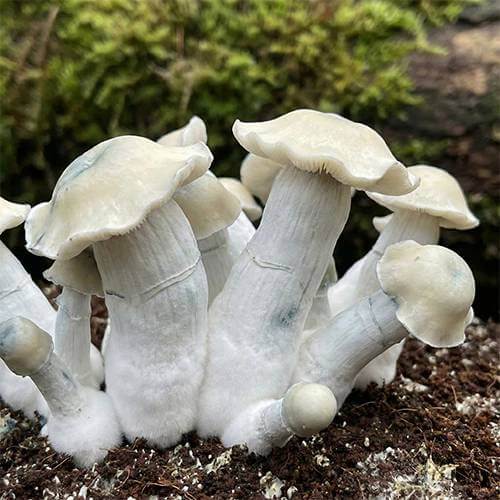
One defining feature often associated with this cultivar is cap coloration. Observations frequently note pale to bluish-white tones in earlier stages, transitioning into light caramel or muted beige hues depending on development phase.
Caps typically display rounded, smooth edges during early formation, gradually flattening with maturity. The contrast between cap surface and underlying tissue makes this variety visually distinctive during documentation.
Stem Traits and Structural Features
Stems are often described as dense and sturdy, with a relatively thick profile compared to more slender cubensis lines. Surface texture may appear smooth, with occasional fibrous detailing visible under magnification.
Structural density is one reason this cultivar attracts collector attention—it demonstrates a robust build that is easier to compare across stabilized samples.
Spore Characteristics Under Microscopy
Under magnification, spores typically exhibit the dark purplish-brown coloration characteristic of cubensis varieties. Shape tends toward elliptical with smooth outer surfaces. Size ranges align with common cubensis standards, though researchers may record slight variations depending on source refinement.
For microscopy documentation, clear visibility and structural integrity make this line appealing to those analyzing mushroom spores for academic or hobbyist research.
Research Insights and Observational Data
Growth Pattern Observations (Microscopy Context Only)
In research settings focused on mycelial observation, isolated lines are often noted for consistent density patterns. Bluey Vuitton has developed a reputation for organized, even mycelial expansion when examined under sterile laboratory conditions.
Colonization observations are typically documented for comparative analysis rather than application. Stability in pattern formation allows researchers to measure traits more accurately over time.
Stability and Reproducibility
The most valuable attribute of isolated lines is reproducibility. When documentation from multiple researchers aligns closely, confidence in strain stability increases. This is particularly important for collectors maintaining detailed strain logs and cross-referencing observations with other cubensis varieties.
Uniform morphology also supports educational comparisons when demonstrating how genetic stabilization impacts structural outcomes.
Comparing Bluey Vuitton to Other Popular Cubensis Varieties
Bluey Vuitton vs Golden Teacher
Golden Teacher is known for broader genetic diversity and recognizable golden caps. In contrast, Bluey Vuitton Isolated Spore Syringes focus on refined, stabilized traits. Researchers comparing the two often note stronger uniformity in the isolated line versus the variability common in traditional Golden Teacher solutions.
Bluey Vuitton vs Penis Envy Variants
Penis Envy varieties are known for dense structural development and distinct morphology. While both lines may emphasize stability, Bluey Vuitton is often described as having more balanced proportions and visually contrasting coloration patterns.
For documentation-focused collectors, the decision often comes down to whether they prioritize dramatic structural differences or refined, stabilized symmetry.
Proper Handling and Storage for Research Use
Sterile Handling Best Practices
All spore syringes intended for microscopy research should be handled with sterile technique. Store syringes in a refrigerator between 35–45°F and keep them sealed in original packaging until ready for observation.
Avoid exposure to excessive heat or direct sunlight, as environmental factors can impact spore integrity. Maintaining consistent storage conditions preserves clarity and research reliability.
Documentation and Labeling
Serious researchers maintain detailed logs that include:
- Strain name
- Batch or vendor source
- Date received
- Storage conditions
- Microscopy observations
Accurate labeling ensures that comparative data remains organized, especially when maintaining multiple cubensis varieties in a personal spore archive.
Who Is Bluey Vuitton Best Suited For?
This cultivar is particularly appealing to:
- Collectors building stabilized strain libraries
- Researchers focused on morphology comparison
- Microscopy hobbyists seeking uniform visual traits
- Advanced enthusiasts documenting hybrid-style genetics
While beginners can certainly study isolated lines, those interested in understanding genetic refinement processes may find the greatest appreciation for this variety.
Pros and Considerations
Pros
- Stabilized genetic expression
- Consistent structural morphology
- Strong collector interest
- Ideal for documentation-based comparison
Considerations
- Less genetic diversity than multi-spore solutions
- Requires careful sterile handling
- Availability may vary depending on supplier
Conclusion
Bluey Vuitton Isolated Spore Syringes represent a modern approach to cubensis research, emphasizing stability, uniformity, and detailed observation. By narrowing genetic variability, isolated lines allow researchers to document structural traits with greater confidence.
For those studying mushroom spores in controlled microscopy settings, this cultivar offers a refined and visually compelling option. With proper handling, accurate documentation, and responsible research practices, Bluey Vuitton continues to hold a respected place among contemporary stabilized cubensis varieties.
FAQs
What makes Bluey Vuitton different from other cubensis varieties?
Its stabilized genetic profile and visually distinctive traits set it apart. Researchers value its uniform morphology for consistent documentation.
Is an isolated spore syringe better than a multi-spore syringe?
It depends on research goals. Isolation supports consistency, while multi-spore solutions offer broader genetic diversity.
How should Bluey Vuitton spore syringes be stored?
Refrigerate between 35–45°F, keep sealed, and protect from light exposure to maintain spore integrity.