

TTBVI Mushroom Spore Print
TTBVI Mushroom Spore PrintCouldn't load pickup availability


TTBVI Spore Print
The Panaeolus cyanescens TTBVI Mushroom Spore Print from Magic Spore Labs delivers basidiospores from one of the most evocatively named and precisely located Caribbean isolations of P. cyanescens in the research print market. TTBVI — Tamarind Tree British Virgin Islands — takes its name directly from its collection origin: first identified near a tamarind tree in the British Virgin Islands, a Caribbean island environment whose warm, humid tropical conditions are well-suited to the nutrient-rich grassland and pasture habitats that Panaeolus cyanescens colonizes across its globally distributed range. Propagated and documented within the mycology research community through contributors including GordoTek, TTBVI carries a traceable lineage that adds provenance depth to its island collection origin.
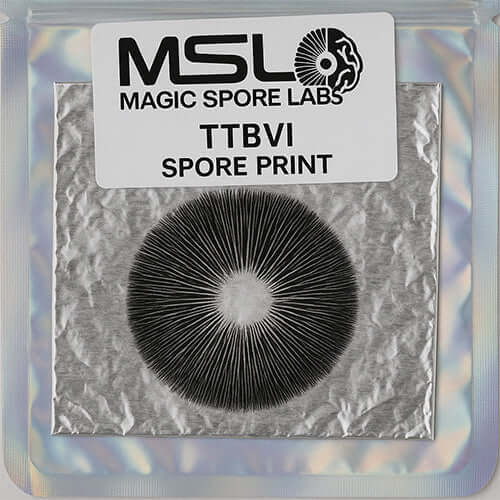
Morphologically, TTBVI delivers the dense jet black, smooth, elliptical basidiospore deposits characteristic of Panaeolus cyanescens — with tetrasporic basidia producing rich, dark print material that renders with strong visual contrast under microscopy examination. For researchers building comparative P. cyanescens reference collections, TTBVI provides a distinct Caribbean island data point that complements domestic U.S. isolations like the Bunnell, Florida collection and the broader global distribution of the species across Hawaii, Southeast Asia, and subtropical regions worldwide. The geographic contrast between island and mainland collection environments makes multi-isolation P. cyanescens comparison genuinely informative for basidiospore morphology research.
Magic Spore Labs produces every TTBVI spore print under GMP-aligned sterile conditions on individually sealed sterile aluminum foil substrate. Refrigeration is recommended for optimal longevity. We ship to researchers across the United States, excluding California, Idaho, and Georgia. All products are sold strictly for microscopy and taxonomy research purposes only.
Every Magic Spore Labs order is GMO-free, vegan, and backed by our genetics guarantee, and ships in discreet, unmarked packaging.
Key Features
British Virgin Islands Tamarind Tree Isolation
The TTBVI variant of Panaeolus cyanescens takes its name from its precise collection origin — discovered near a tamarind tree in the British Virgin Islands, giving this print a geographically specific Caribbean provenance that distinguishes it meaningfully from domestic U.S. and tropical Asian P. cyanescens isolations.
Cleanroom Prepared
Each spore print is collected and prepared in a controlled cleanroom environment using strict sterile technique, minimizing contamination and preserving clean, viable spores for microscopy.
Dense Jet Black Deposits, Foil-Preserved
Panaeolus cyanescens TTBVI prints are characterized by dense jet black basidiospore deposits — individually sealed on sterile aluminum foil substrate with refrigeration recommended for optimal longevity and spore integrity.
Community-Documented Caribbean Lineage
Propagated and documented within the mycology research community through contributions from collectors including GordoTek, TTBVI carries a traceable community lineage that adds provenance depth to its Caribbean wild-collect origin — a well-recorded isolation history for a geographically distinct P. cyanescens variant.
Named for a Caribbean tamarind tree — a precisely located Panaeolus cyanescens island isolation
Product Details
Product Includes
Frequently Asked Questions
What is a Panaeolus cyanescens TTBVI spore print?
How do you store Panaeolus cyanescens TTBVI spore prints?
Does Magic Spore Labs ship Panaeolus cyanescens TTBVI spore prints to my state?
How does the TTBVI isolation compare to other Panaeolus cyanescens isolations like Bunnell, Florida?
What is the significance of the tamarind tree collection origin for the TTBVI variant?
Never Miss an Update
Add magicsporelabs.com as a Preferred Source on Google to see more of our content in AI Mode and AI Overviews.