

Cyanescen Mushroom Spore Print
Cyanescen Mushroom Spore PrintCouldn't load pickup availability


Cyanescen Spore Print
The Psilocybe cyanescens Wavy Cap Mushroom Spore Print from Magic Spore Labs offers researchers basidiospores from one of mycology's most historically anchored and morphologically distinctive Psilocybe species — a temperate woodland native whose formal scientific description dates to 1946, when British mycologist Elsie Wakefield first documented specimens collected at the Royal Botanic Gardens, Kew. That Kew Gardens origin gives Psilocybe cyanescens one of the most precisely recorded type descriptions in the genus, a provenance that has anchored its taxonomy research significance across nearly eight decades of subsequent mycological study.
Since Wakefield's original description, P. cyanescens has naturalized extensively across temperate regions of North America and Europe — colonizing wood-chip mulch beds, lignin-rich garden substrates, and urban green spaces with a consistency that has made it one of the most geographically accessible Psilocybe species for field documentation and comparative research. Its morphology is immediately recognizable: a hygrophanous caramel to chestnut-brown cap with characteristically wavy margins at maturity, dark purple-brown basidiospore deposits, and a notable bluing reaction when tissue is damaged — a chemically reactive trait that distinguishes it clearly from Psilocybe cubensis under both field observation and microscopy examination.
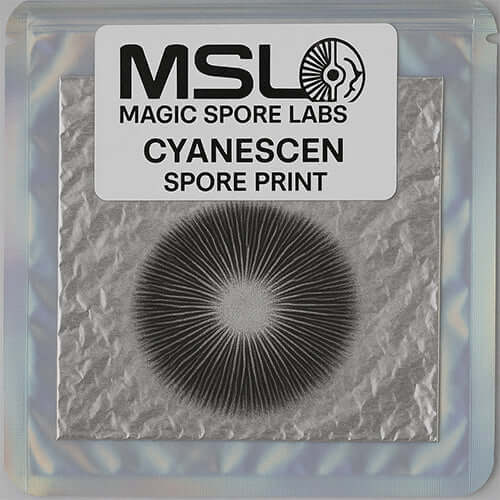
Magic Spore Labs produces every Psilocybe cyanescens spore print under GMP-aligned sterile conditions, depositing a dense, uncontaminated basidiospore sample onto individually sealed sterile aluminum foil substrate. Prints store at ambient temperature for up to 24 months with no refrigeration required. We ship to researchers across the United States, excluding California, Idaho, and Georgia. All products are sold strictly for microscopy and taxonomy research purposes only.
Every Magic Spore Labs order is GMO-free, vegan, and backed by our genetics guarantee, and ships in discreet, unmarked packaging.
Key Features
Wakefield's 1946 Kew Gardens Type Specimen
Psilocybe cyanescens was first formally described by British mycologist Elsie Wakefield in 1946 from specimens collected at Kew Gardens — one of the most precisely anchored type descriptions in the Psilocybe genus, giving these spore prints a direct taxonomic connection to one of mycology's landmark species descriptions.
Cleanroom Prepared
Each spore print is collected and prepared in a controlled cleanroom environment using strict sterile technique, minimizing contamination and preserving clean, viable spores for microscopy.
Dark Purple-Brown Deposits, Foil-Preserved
Psilocybe cyanescens prints are characterized by deeply pigmented dark purple-brown basidiospore deposits — individually sealed on sterile aluminum foil substrate for long-term ambient storage stability with no refrigeration required.
Globally Naturalized, Temperate Woodland Native
Originally documented in the UK and now naturalized across temperate regions of North America and Europe, P. cyanescens represents one of the most geographically widespread wood-chip associated Psilocybe species — making it an essential multi-regional reference specimen for comparative temperate Psilocybe taxonomy research.
First described at Kew Gardens in 1946 — mycology's most widely naturalized wavy cap
Product Details
Product Includes
Frequently Asked Questions
What is a Psilocybe cyanescens wavy cap spore print?
How do you store Psilocybe cyanescens wavy cap spore prints?
Does Magic Spore Labs ship Psilocybe cyanescens spore prints to my state?
What is the difference between Psilocybe cyanescens and Psilocybe cubensis spore prints?
Why is Psilocybe cyanescens considered one of the most significant species in the Psilocybe genus for taxonomy research?
Never Miss an Update
Add magicsporelabs.com as a Preferred Source on Google to see more of our content in AI Mode and AI Overviews.