Skip to product information
1 of 1

Azurescen Mushroom Spore Print

Azurescen Mushroom Spore Print
Regular price $26.99
Regular price Sale price $26.99
Sale Sold out
Shipping calculated at checkout.
Quantity
Discreet Shipping
GMP Certified
Genetics Guarantee
GMO Free
ISO 7 Cleanroom
Vegan
Delivery Information
1
Processing
1–2 business days
2
Discreet Delivery
2–5 business days
3
Carriers
USPS Priority · UPS 2-Day
4
Tracking
Provided after shipment
Spore Print
Format
Multi-Spore
Spore Type
GMP
Lab Certified

Azurescen Spore Print

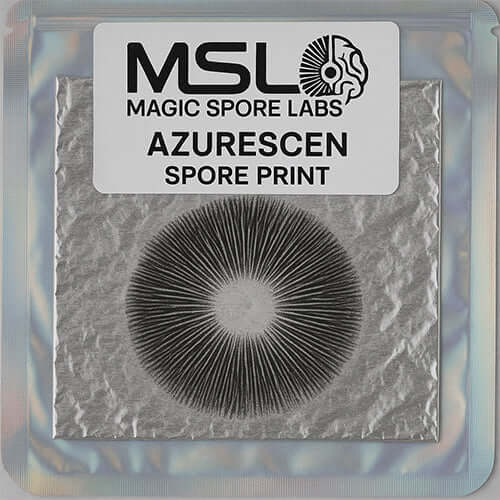
The Azurescen Spore Print offers a vibrant window into one of the most visually striking spore varieties available to microscopy researchers. This particular print showcases a deep, dark purplish-brown spore coloration, neatly distributed across an aluminum foil sheet, offering ample material for both seasoned and new researchers. Its unique pigment and dense print structure make it ideal for in-depth observation under high-resolution microscopes.

Collected in sterile lab conditions and sealed for protection, each Azurescen Spore Print is packaged in a clear, labeled baggy that ensures long-lasting integrity during storage and transport. Researchers will appreciate the well-preserved spore characteristics, which highlight the natural beauty and genetic variance found within this fascinating species. Its distinct features make it a standout for taxonomy or side-by-side comparison studies with other prints.

Whether you're building your microscopy library or conducting comparative mycological studies, this Azurescen Spore Print delivers high research value and visual intrigue. Intended solely for microscopic examination and research.
View full details

Key Features

Stamets & Gartz 1995 Formally Described Species

Psilocybe azurescens was formally described by Paul Stamets and Jochen Gartz in 1995 — one of the most precisely documented species descriptions in modern Psilocybe taxonomy, with a confirmed type location on the Columbia River Delta near Astoria, Oregon, giving these prints a direct connection to a landmark moment in Pacific Northwest mycology.

GMP Sterile Print Production

Each Psilocybe azurescens spore print is produced in a GMP-aligned cleanroom environment using strict sterile technique, delivering a dense, uncontaminated basidiospore deposit suitable for serious academic and taxonomic microscopy research.

Dark Purple-Brown Deposits, Foil-Preserved

Psilocybe azurescens prints are characterized by deeply pigmented dark purple-brown basidiospore deposits — individually sealed on sterile aluminum foil substrate for long-term ambient storage stability with no refrigeration required.

Columbia River Delta Type Location

With a formally recorded type location on the Columbia River Delta near Astoria, Oregon, P. azurescens carries one of the most geographically precise provenances in the Pacific Northwest Psilocybe research catalog — a dune grass and wood debris habitat specialist with a verifiable domestic U.S. collection origin.

Formally described in 1995 on the Columbia River Delta — the Pacific Northwest's most documented Psilocybe

Psilocybe azurescens was formally described by mycologist Paul Stamets and German researcher Jochen Gartz in 1995, with a type location recorded on the Columbia River Delta near Astoria, Oregon — one of the most precisely anchored species descriptions in modern Psilocybe taxonomy. Originally discovered by a Boy Scout troop camping near the mouth of the Columbia River in 1979, the species was subsequently collected, studied, and formally described over the following decade and a half. A specialist of coastal dune grass, sandy soils, and wood debris in cool Pacific Northwest environments, P. azurescens produces large, caramel to chestnut-brown hygrophanous caps with a pronounced bluing reaction when tissue is damaged — and deeply pigmented dark purple-brown basidiospore deposits that make it a compelling specimen for comparative Psilocybe microscopy and taxonomy research.

Product Details

Specimen
Species Psilocybe azurescens
Strain Wild-type (species-level specimen)
Spore type Multi-spore
Genetics Wild-collect Pacific Northwest coastal lineage
Origin Columbia River Delta, Astoria, Oregon, USA (type location)
Specifications
Solution Dry spore deposit on aluminum foil substrate
Storage Cool, dry place — away from direct light and humidity
Shelf life Up to 24 months when stored properly

Product Includes

1x
Psilocybe azurescens Spore Print
Dense multi-spore deposit on sterile aluminum foil

Frequently Asked Questions

What is a Psilocybe azurescens spore print?
A Psilocybe azurescens spore print is a dry deposit of dark purple-brown basidiospores from the flying saucers mushroom — a Pacific Northwest coastal Psilocybe species formally described by Paul Stamets and Jochen Gartz in 1995, with a confirmed type location on the Columbia River Delta near Astoria, Oregon. Originally discovered near the mouth of the Columbia River in 1979, P. azurescens is a dune grass and wood debris specialist characterized by large hygrophanous caramel to chestnut-brown caps and a pronounced bluing reaction when tissue is damaged. All prints are sold strictly for microscopy and taxonomy research purposes only.
How do you store Psilocybe azurescens spore prints?
Psilocybe azurescens spore prints should be stored in a cool, dry location away from direct light and humidity — an airtight envelope or sealed container kept at ambient room temperature is sufficient for long-term preservation. No refrigeration is required under standard conditions, and prints remain viable for microscopy research for up to 24 months when stored properly.
Does Magic Spore Labs ship Psilocybe azurescens spore prints to my state?
Magic Spore Labs ships Psilocybe azurescens spore prints to researchers across the United States, with the exception of California, Idaho, and Georgia, where state law restricts spore shipments. All orders are packaged discreetly and securely and are sold strictly for microscopy and taxonomy research purposes only.
What is the difference between Psilocybe azurescens and Psilocybe cyanescens spore prints?
Psilocybe azurescens and Psilocybe cyanescens are closely related Pacific Northwest temperate Psilocybe species, both producing dark purple-brown basidiospore deposits and exhibiting a bluing reaction when tissue is damaged — but they differ meaningfully in habitat, morphology, and geographic range. P. azurescens is a coastal dune grass and sandy soil specialist with a more restricted native range centered on the Columbia River Delta region, while P. cyanescens is a wood-chip and urban substrate generalist naturalized broadly across temperate North America and Europe. Morphologically, azurescens produces notably larger caps than cyanescens and lacks the pronounced wavy cap margins that define that species at maturity, making the two readily distinguishable under direct comparison.
What is the discovery and formal description history of Psilocybe azurescens?
Psilocybe azurescens has one of the more precisely documented discovery histories in modern Psilocybe taxonomy. The species was first encountered in 1979 by a Boy Scout troop camping near the mouth of the Columbia River in Oregon — a collection that eventually made its way into mycological research channels. Paul Stamets studied the specimens over the following years before formally describing the species alongside German mycologist Jochen Gartz in 1995, designating the Columbia River Delta near Astoria, Oregon as the official type location. That combination of a specific discovery year, a named discovery circumstance, and a formally recorded type location gives P. azurescens one of the most complete provenance records of any species formally described in the Psilocybe genus during the late twentieth century.
Disclaimer: Psilocybe cubensis spores are intended for microscopic research and identification purposes only. Not for human consumption. Not for sale in CA, ID, FL, or GA. Any communication implying intent to cultivate will result in order cancellation and future purchase denial.

Never Miss an Update

Add magicsporelabs.com as a Preferred Source on Google to see more of our content in AI Mode and AI Overviews.

★ Add to Preferred Sources